Confirm the purpose
Before the visit, the consultant reviews why the survey is needed and any wording, plans or documents that define the question.
Arboricultural Consultants South East · Elmbridge
Tree survey Elmbridge — independent site inspection and arboricultural advice for planning, property, tree condition and specialist requirements across the local authority area.
Not sure what type of tree survey has been requested? Send us the wording, plans or concern and we will help define the survey scope before you instruct.
FREE · NO OBLIGATION
Add your details below. If you are not sure which tree survey or arboricultural service you need, leave the service as “Not sure — help me choose”.
Our team will review your project and reply to . If we need more information to prepare your quote, we’ll get in touch.
This is an enquiry, not a booking. We’ll agree the scope and fee before you instruct us.
Prefer to talk? 0204 531 6444 · Email us
Please enable JavaScript to send this form, or use the phone/email links above.
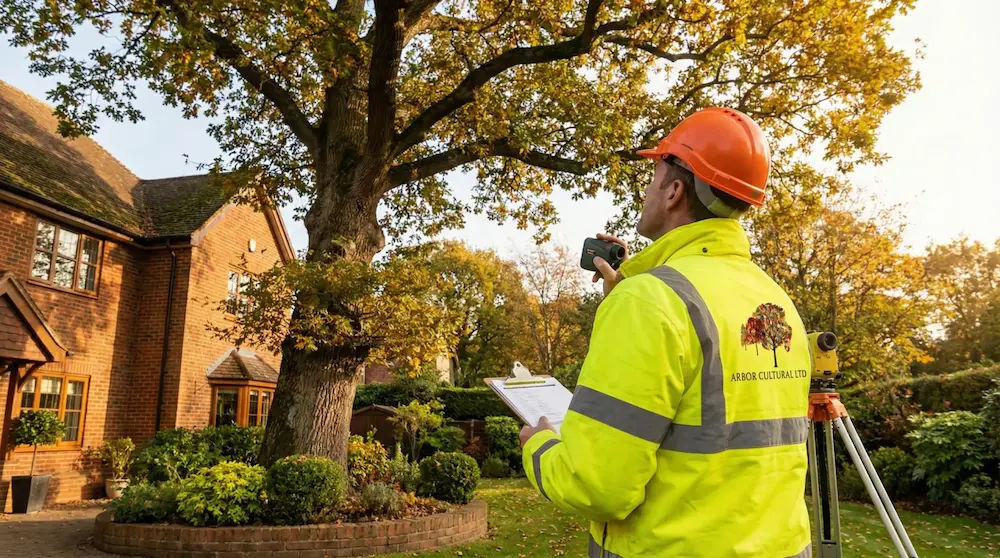
The site visit
A tree survey should be scoped around the reason you need it. The site visit gathers the evidence; the professional value comes from recording and interpreting the right information for that instruction.
Before the visit, the consultant reviews why the survey is needed and any wording, plans or documents that define the question.
The surveyor records the trees and site relationships that matter to the instruction, including relevant neighbouring trees where appropriate.
Depending on scope this can include species, dimensions, condition observations, defects, rooting context, photographs and mapped information.
The output should make clear what can be concluded, what is outside scope and whether further planning documentation or specialist investigation is needed.
When to commission one
The phrase “tree survey” can mean different things. These are common reasons clients contact Arbor Cultural for a site-specific inspection.
Trees are on or near a proposed extension, new building, access route or redevelopment and arboricultural information is required.
A surveyor, lender or insurer has raised a tree-related concern and needs independent arboricultural evidence.
You have noticed a defect, decline, damage or other issue and want a professional assessment of the tree and site context.
Work is proposed close to retained trees and the project team needs to understand constraints before excavation, access or services are finalised.
A TPO, conservation area or planning condition may affect what can be done and professional advice is needed before making an application.
A visual inspection may identify a question that requires decay testing, root investigation or another specialist technique.
See Tree Surveys | Elmbridge for the broader local survey hub covering BS5837, property, condition and specialist survey routes.
Elmbridge local context
A tree survey in Elmbridge should begin with the reason for the instruction, not a generic checklist. The surveyor needs to know whether the site visit is supporting planning, a property decision, a condition concern or another arboricultural question.
For sites around Weybridge, Walton-on-Thames and Esher, relevant trees may stand inside the site, along a boundary or on neighbouring land. What matters is whether their crowns, stems, roots or management context are relevant to the question being answered.
The result should be clear enough for the client or other professional to act on. Measurements and observations are useful only when they are interpreted in the context of the instruction and any limitations are explained.
Elmbridge says trees are considered as part of the planning process whether or not they are protected by a Tree Preservation Order or conservation-area controls.
Its building-near-a-tree guidance says BS5837:2012 information is needed to support an application where development may affect trees, and warns that missing information can lead to invalidation or refusal.
The council also encourages professional advice from arboricultural consultants so the supporting survey, impact and protection information matches the site and proposal.
How it works
The process should be simple for the client even when the technical issue is complex.
Provide the address, the reason for the survey and any council, lender, surveyor or project wording you already have.
Arbor Cultural reviews what the survey needs to answer and confirms the proposed scope before professional work is instructed.
The consultant attends the site and records the evidence relevant to the agreed purpose, with limitations noted where access or visibility is restricted.
The findings are interpreted for the intended decision and the next step is explained, including any further documents or specialist investigation if required.
Survey fees
There is no useful single price for every survey because the work can range from one tree at a residential property to a larger planning site with many trees and detailed drawings.
The most important thing is to agree the purpose and scope first. A lower-priced survey that does not answer the planning, lender, property or safety question can create more cost later if the work has to be repeated.
Send the postcode, reason for the survey and any plans or written requirements. That gives the consultant enough context to identify the likely work and explain what is included in the proposal.
If the survey is for planning
If the purpose is development, the correct route may be a BS5837 tree survey rather than a general condition inspection. The survey provides structured tree information that can inform design and later planning documents.
Once a proposal exists, further work can include an Arboricultural Impact Assessment, Tree Protection Plan or Arboricultural Method Statement. These are separate stages with different purposes, which is why the instruction should be scoped before the site visit rather than assuming every “tree survey” means the same thing.
Include the site address, the reason for the survey, the latest drawings if relevant and the exact wording supplied by the council, lender, insurer, building surveyor or other professional.
You do not need to diagnose the report type yourself. The purpose of the enquiry is more useful than guessing the technical name.
Useful reading
These Arbor Cultural guides explain the planning and technical steps that commonly follow a tree survey.
What a practical Tree Protection Plan should communicate to the site team.
A practical explanation of retention categories and what they do — and do not — mean.
Why trees can matter to foundations and building-control decisions as well as planning.
A real Arbor Cultural project showing the planning-document chain in practice.
Why Arbor Cultural
Arbor Cultural is a consultancy rather than a tree-work contractor. The aim is to define the question, inspect what is relevant and provide clear professional evidence without needing to sell follow-on pruning or felling work.
Elmbridge questions answered
Clear answers to common questions before you instruct.
Elmbridge says trees are considered in planning whether protected or not. Where development may affect trees, BS5837 information can be needed to support the application.
Yes. The council validation wording includes trees on adjacent land and street trees where they can influence or be affected by the proposed development.
Depending on the proposal, the package can include the tree survey, Arboricultural Impact Assessment, Tree Protection Plan and Arboricultural Method Statement.
Elmbridge encourages professional arboricultural advice. Arbor Cultural can scope the survey and planning documents against the site and council wording.
The survey is scoped around the reason for the instruction. It can include tree identification, measurements, condition observations, site relationships, photographs, mapped information and other evidence relevant to the question being answered.
Possibly. Where trees on or near a site may influence development, arboricultural information can be relevant. The exact requirement depends on the proposal and current requirements of Elmbridge Borough Council.
A BS5837 survey records relevant trees and groups in a structured way for design and development decisions. It can provide the baseline evidence for later impact-assessment and tree-protection documents.
Yes. Trees do not have to be inside the site boundary to be relevant if their crowns, rooting areas or relationship with proposed works could influence the site.
Yes. Property instructions should be scoped around the wording from the buyer, lender, insurer or building surveyor rather than assuming a planning survey is appropriate.
A condition-focused survey can consider visible defects, tree condition, site use and proportionate management. Some situations may require further specialist investigation.
Yes. The quote form accepts optional files, and documents can also be emailed to admin@arbor-cultural.co.uk.
The fee depends on the number of trees, site size, access, purpose, drawings required, specialist testing and the required output. Arbor Cultural confirms the scope and fee before instruction.
No. Start with the problem, project or wording you received. Arbor Cultural can help identify the appropriate survey scope before you instruct.
No. It starts an enquiry. The proposed scope and fee are agreed before professional work is instructed.
Tree survey · Elmbridge
Use the quote form at the top, or email plans, photographs and council or lender wording to admin@arbor-cultural.co.uk.