Tree identification
Species or taxon, tree reference, location and the basic information needed to identify the tree consistently across plans and reports.
Planning application, property purchase, insurer request, tree-safety concern, protected tree or specialist diagnostic problem? Start with the reason you need help — we’ll identify the appropriate survey, report or arboricultural service.
FREE · NO OBLIGATION
Tell us what prompted the enquiry. A consultant will review the site, council / lender / insurer wording or tree concern and help identify the right survey, report or specialist service before sending a fixed-fee proposal.
Our team will review your project and reply to . If we need more information to prepare your quote, we’ll get in touch.
This is a request for a quote; your instruction is confirmed once the scope and fee are agreed.
Prefer to talk?
0204 531 6444
Or
email your plans, letter or existing report
.
The correct service depends on the decision you are trying to make. Planning work may need BS5837 documents; a lender or insurer may need a property report; tree owners may need a condition or safety survey; and concerns about decay, roots, subsidence or protected trees may need specialist evidence. You do not need to diagnose the service yourself.
This page is deliberately broad. It helps you find the correct specialist page without turning every enquiry into the same generic “tree survey”.
| Your situation | Likely starting service | Typical purpose | Go to service |
|---|---|---|---|
| I am applying for planning permission near trees | BS5837 Tree Survey | Baseline tree information and constraints for design / planning. | BS5837 survey → |
| The council wants an impact assessment | Arboricultural Impact Assessment | Assessment of how the actual proposal affects retained trees. | AIA → |
| I have a tree-related planning condition to discharge | TPP / AMS / Supervision | Construction protection, methods and professional oversight. | AMS → |
| My lender or insurer has asked about trees | Mortgage & Insurance Tree Report | Property-focused arboricultural evidence for the requesting party. | Mortgage / insurance → |
| There are cracks or suspected structural movement | Tree Subsidence Assessment | Tree evidence considered with structural, soil, monitoring and root evidence. | Subsidence → |
| Building Control needs information about nearby trees | Building Control Tree Survey | Relevant vegetation information for foundation / shrinkable-soil design. | Building Control → |
| I am worried a tree may be unsafe | Tree Health & Safety Report | Condition, foreseeable risk and proportionate management advice. | Tree safety → |
| The tree may have internal decay | Tree Decay Detection | Targeted diagnostic investigation where visual inspection is not enough. | Decay testing → |
| I need to know where roots actually are | Air Spade Root Investigation | Controlled exposure of roots / soil to answer a specific site question. | Root investigation → |
| My tree is protected or in a Conservation Area | TPO / Conservation Area Advice | Applications, notices, evidence, objections and proposed tree works. | Protected trees → |
| I have a high hedge / technical tree dispute | High Hedge / Expert Advice | Independent technical evidence for disputes and formal processes. | High hedge → |
Use the categories below to move directly to the specialist service. Each child page goes deeper on its own subject; this hub stays focused on helping you choose the right route.
From the first tree survey through design, application, condition discharge and construction-stage supervision.
Reports for property purchase, lending, insurance, foundation design and suspected tree-related movement.
Condition-focused surveys that help tree owners and duty holders understand defects, priorities and proportionate management.
Specialist investigation when a visual inspection cannot answer the structural, decay, root or physiological question.
Independent evidence for TPOs, Conservation Areas, high hedges and other technically sensitive tree matters.
Independent specialist opinion for disputes, litigation and cases where a standard survey is not enough.
The terms are often used interchangeably online, but separating them helps you understand what you are actually paying for.
The consultant attends the site and records the information needed for the agreed purpose — for example species, dimensions, condition, tree position, defects, targets or planning constraints.
The raw observations are interpreted against the purpose of the instruction, relevant standards, plans, property information or specialist evidence.
The output communicates the conclusions in a form the client, planning authority, lender, insurer, engineer or duty holder can use.
Specialist testing should answer a real uncertainty. It should not be added simply to make a report look more technical.
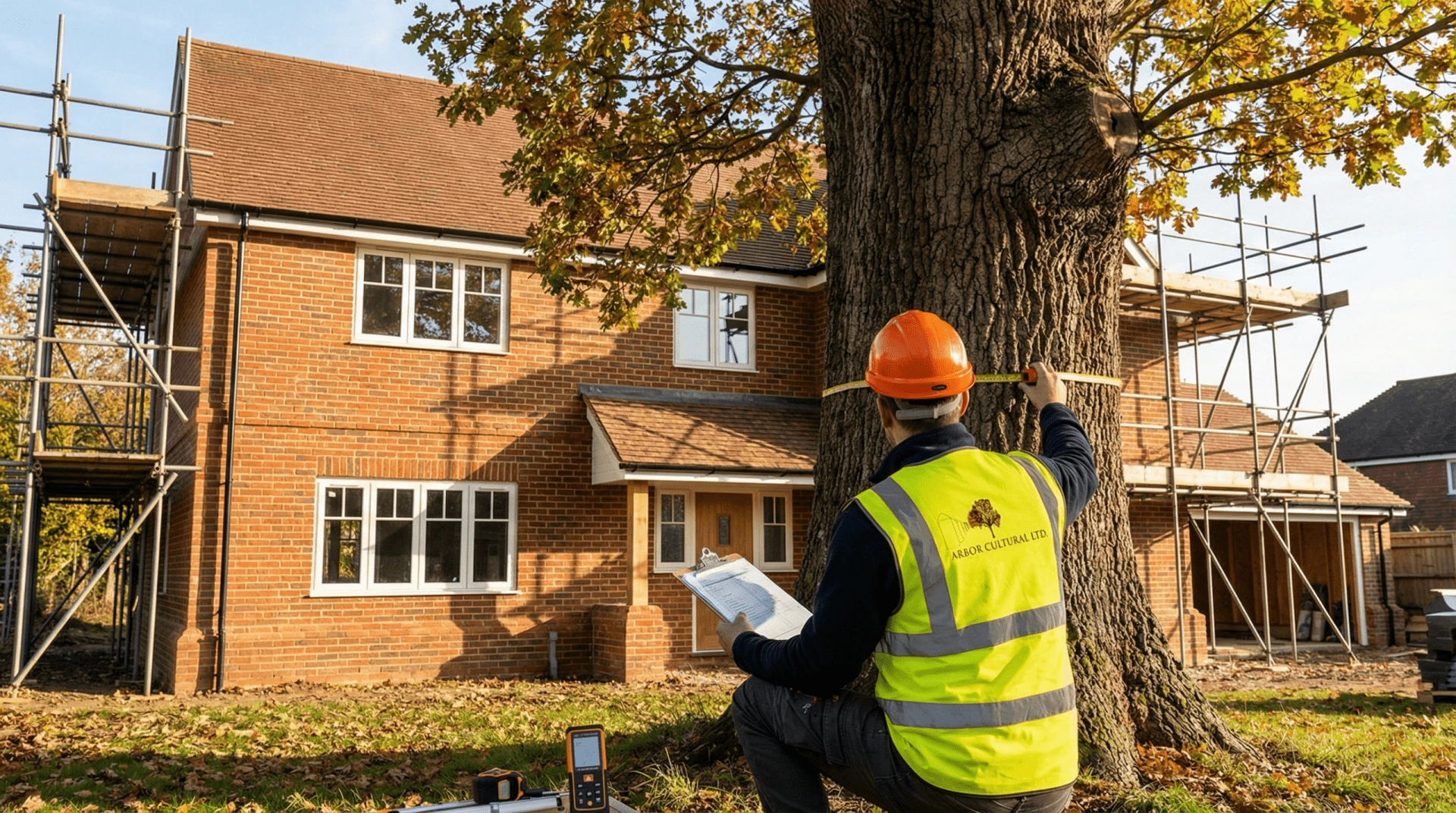
The dataset changes with the purpose. A planning survey is not the same as a safety inspection, and a mortgage report is not the same as a subsidence investigation.
Species or taxon, tree reference, location and the basic information needed to identify the tree consistently across plans and reports.
Relevant measurements can include stem diameter, height, crown spread, crown clearance and other dimensions required by the survey type.
Age class, physiological condition, growth characteristics and observed vitality can help explain current and future tree behaviour.
Visible defects, cavities, unions, damage, fungal features, deadwood and other condition information can be recorded where relevant.
Buildings, boundaries, roads, paths, targets, neighbouring trees, levels and proposed works can all affect how the tree information is interpreted.
BS5837 work can include retention categories, Root Protection Areas, crown constraints and other information used by the design team.
Mortgage, insurance and Building Control work may focus on distance, species, growth potential, direct damage and soil / foundation context.
Where the purpose requires it, the report can prioritise pruning, monitoring, further investigation, protection or other proportionate action.
A professional report should say what could and could not be inspected and where conclusions depend on information outside the arboricultural scope.
A useful report is written for the decision being made, not simply to create a long PDF.
Property purchase, mortgage, insurance, protected-tree, safety, neighbour and specialist diagnostic questions.
BS5837 surveys, constraints plans, impact assessments, protection plans, method statements and construction-stage support.
Clear arboricultural evidence that can be coordinated with drawings, design changes, planning submissions and conditions.
Tree condition, safety, prioritised management and specialist investigation for larger tree populations or high-use sites.
Property-specific arboricultural information where a mortgage, insurance, subsidence or building-related question has been raised.
Independent arboricultural evidence for cases that require greater technical or legal formality than an ordinary survey.
Arbor Cultural is a consultancy rather than a tree-surgery contractor. That distinction is particularly useful when a client needs an independent view on whether a tree should be retained, monitored, tested, protected, pruned or removed.
The consultancy does not benefit financially from recommending pruning or felling work.
A specialist test is only useful when it resolves an uncertainty that matters to the decision.
Planning, construction, property and diagnostic work can be coordinated so each document builds on reliable earlier information.
Send the site or property address, explain what prompted the enquiry and include the exact wording from the council, lender, insurer, surveyor or project team where relevant.
We identify which survey, report, plan or diagnostic service appears appropriate and flag anything important that is missing before instruction.
The scope, deliverables and fee are set out clearly so you know what is being commissioned.
A consultant attends the site and records the information needed for the agreed purpose.
Survey evidence is interpreted in context and translated into the report, plan, recommendations or diagnostic output required.
The finished information can support the relevant council, lender, insurer, property or project process, with additional stages scoped separately where needed.
Broad competitor pages often advertise a starting price, but a general hub covers very different jobs. The fair comparison is scope: what has to be inspected, analysed, drawn, tested and reported for the specific decision.
Purpose: planning, mortgage, safety, TPO, subsidence and specialist diagnostics all require different work.
Tree numbers and site size: one tree beside a house is different from a development or estate with a large tree population.
Plans and drawings: some planning outputs need suitable topographical and design information.
Access: off-site trees, restricted areas and large sites can change survey time and limitations.
Specialist testing: sonic tomography, Resistograph, Air Spade or vitality testing should only be included where justified.
Reporting complexity: a short property report and a multi-stage planning or technical evidence package are not equivalent instructions.
Send the address or postcode and whatever prompted the request. If there is a council letter, lender wording, insurer email or drawing, upload it with the enquiry.
Get my fixed-fee quote →Decision notice, validation request, planning condition, proposed layout, topographical survey and any existing tree information.
The exact request, property postcode, building survey and relevant photographs normally give the clearest starting point.
Photographs, access details, occupancy information and the reason you are concerned about the tree or site.
Existing tree reports, photographs, defect location and the specific uncertainty that further testing is intended to answer.
Tree location, proposed works, council correspondence and any existing refusal, consent or application documents.
Planning submission, exchange, completion, insurer, construction or legal deadlines help the team tell you what is realistically achievable.
A short Arbor Cultural video about professional tree survey and reporting standards.

Published feedback from clients who have commissioned planning, property, tree-safety and specialist arboricultural work.
These are service areas, not claimed office locations. Open a region to see the named towns and localities covered.
This hub answers broad questions and links to specialist pages for deeper technical detail.
A tree survey is a structured inspection and record of trees for a defined purpose. The information collected depends on the instruction: a planning survey records BS5837 data and constraints, a safety survey focuses on condition and risk, and a mortgage or property survey focuses on the relationship between trees and the property.
A tree report is the written professional output that explains the survey findings, limitations, conclusions and recommendations. Some jobs need a survey schedule and plan; others need a fuller report, impact assessment, method statement, safety report or specialist diagnostic interpretation.
The survey is the inspection and evidence-gathering stage. The report is the professional interpretation and communication of that evidence. On many projects the two are commissioned together.
That depends on why the survey has been requested. Planning applications commonly need BS5837 work; lenders and insurers may request a property report; tree owners may need a health and safety inspection; and suspected decay, roots or subsidence may need specialist investigation.
Yes. Send the validation requirement, planning condition, decision notice or email from the planning officer. The wording is usually more useful than trying to choose a technical report name yourself.
Where trees on or near a site could influence a proposed development, the planning authority may require tree information prepared in accordance with BS5837. The exact documents depend on the proposal and stage of the project.
Depending on the project, the sequence can include a tree survey and schedule, Tree Constraints Plan, Arboricultural Impact Assessment, Tree Protection Plan, Arboricultural Method Statement and arboricultural supervision.
A Tree Constraints Plan translates survey data into mapped constraints such as tree positions, crowns and Root Protection Areas so the design team can understand the space that retained trees need.
An AIA considers how a proposed design affects retained trees and how tree-related constraints interact with buildings, access, levels, surfacing, services, demolition and other works.
A Tree Protection Plan is the drawing that shows how retained trees are to be protected during demolition and construction, including protective barriers, controlled working areas and other measures where required.
An AMS explains how sensitive operations near retained trees will be carried out, including sequencing, access, excavation, surfacing, services, demolition or other project-specific methods.
Arboricultural supervision is consultant attendance or monitoring during specified construction operations where the planning condition, approved documents or site circumstances require professional oversight and records.
Yes. Send the exact condition wording and approved drawings. The consultant can identify whether the authority is asking for an AMS, TPP, supervision, updated information or another arboricultural submission.
Yes. Building Control or warranty-related tree surveys can provide relevant vegetation information for the design team where foundation depth, shrinkable soil and nearby trees need to be considered.
Yes. Mortgage and pre-purchase reports can address tree condition, direct damage, potential indirect damage, neighbouring vegetation and practical management where a lender, insurer or building surveyor has raised trees.
Yes. If an insurer has asked for an arboricultural report, send the exact wording so the scope can be matched to the question being asked. Existing structural movement may require a separate subsidence investigation.
Yes. Suspected tree-related subsidence is a different investigation from a standard mortgage report and should be considered alongside the available structural, monitoring, soil, foundation, drainage and root evidence.
Yes. Condition and safety surveys can cover individual trees, groups or larger sites and can help owners and duty holders prioritise inspection, management and further investigation.
Homeowners, schools, estates, landlords, commercial sites, managing agents, charities and other landowners may need proportionate tree-inspection arrangements depending on occupancy, tree stock and foreseeable risk.
A condition-focused survey can record species, dimensions, vitality, significant defects, structural condition, visible fungal features, targets, management priorities and recommendations appropriate to the scope.
Where a specific defect or internal condition cannot be resolved visually, a consultant may recommend targeted diagnostic work such as sonic tomography, Resistograph testing, root investigation or another proportionate method.
Sonic tomography uses sensors around a stem to measure sound transmission and build an image that can assist the assessment of suspected internal decay or structural condition.
Resistograph testing uses a fine drilling needle to record changes in resistance through wood. It can provide targeted information about cavities, decay or changes in wood condition.
An Air Spade uses compressed air to move soil with less mechanical damage to woody roots than conventional digging. It can be useful where actual root location or root condition needs to be investigated.
Vitality testing can provide physiological evidence about how actively a tree is functioning. It is most useful where that information answers a specific management, establishment or diagnostic question.
Yes. Arbor Cultural provides independent advice for TPO applications, Conservation Area matters, objections, proposed works and evidence where protected trees are involved.
Where the proposed work and statutory position require it, Arbor Cultural can advise on the appropriate tree-work notification or application route and the supporting arboricultural information.
Yes. High hedge consultancy can assess qualifying evergreen or semi-evergreen hedges, relevant measurements and the technical information used in the local-authority complaint process.
Yes. Complex disputes and litigation may require independent expert evidence rather than a standard tree survey. The scope should be agreed from the actual legal or technical instruction.
No. Arbor Cultural is an arboricultural consultancy rather than a tree-surgery contractor. The company provides surveys, reports, diagnostic testing and professional advice rather than selling pruning or felling work.
Separating consultancy from contracting helps keep the recommendation focused on the evidence and the client's actual problem rather than on generating follow-on tree-work income.
Arboricultural reports are prepared and reviewed within Arbor Cultural's consultancy team. The appropriate consultant depends on the service, complexity and specialist evidence required.
Send the site or property location, explain what prompted the enquiry and attach any useful council letter, planning condition, drawings, lender or insurer wording, building survey, photographs or existing tree report.
No. You do not need technical tree knowledge to ask for a quote. Clear photographs, the site address and the wording from the organisation requesting the report are normally more useful.
Relevant off-site trees can often be considered where they may influence planning, property, safety or root-related questions. Access and visibility limitations are recorded where necessary.
Yes. A planning project can move from survey and constraints information to impact assessment, protection planning, method statements and supervision. Property and diagnostic cases can also move into more specialist work if new evidence is needed.
Fees depend on the survey purpose, number of trees, site size, access, location, drawing quality, reporting complexity and specialist testing required. Arbor Cultural reviews the scope and provides a fixed-fee proposal before instruction.
No. A one-tree property report and a multi-stage development package are fundamentally different instructions. The quote is based on the work actually required rather than forcing every enquiry into one generic price.
Turnaround depends on location, access, survey type, current workload and the complexity of the deliverables. Add any genuine planning, exchange, construction or insurer deadline to the enquiry so availability can be confirmed.
Sometimes. Existing information can be reviewed for age, scope, quality, site changes and compatibility with the current project. If it is no longer reliable, an updated survey may be recommended.
They can include relevant trees outside the site boundary where the purpose of the survey requires them and they can be reasonably assessed. The extent should be proportionate to the instruction.
Planning work can use suitable topographical or design information so tree constraints and project relationships can be communicated spatially. The required base information depends on the deliverable.
In BS5837 planning work, the Root Protection Area is a calculated area associated with a tree that is used to inform design and protection. It is one planning constraint, not a literal map of every root.
BS5837 uses categories to communicate the quality and value of trees in a planning context. The categories help the design team and planning authority understand which trees are more or less significant constraints.
Only where removal is justified by the purpose and evidence of the instruction. Many reports recommend retention, monitoring, pruning, design changes or further investigation instead.
Yes. Tree condition, safety and management surveys can be scoped for schools, estates, commercial property, managing agents and other organisations responsible for larger tree populations.
Yes. Some instructions concern one tree; others involve hundreds. The correct method and report should match the decision that needs to be made.
Yes. A pre-purchase or mortgage tree report can provide professional information about relevant trees before exchange, whether or not the lender has formally required it.
Yes. Arbor Cultural works across Greater London, Surrey, West Sussex, East Sussex, Kent, Hampshire, Berkshire, Buckinghamshire and Oxfordshire, with individual project coverage depending on the service.
A consultant reviews the purpose of the enquiry and the information supplied, identifies the likely scope, asks for anything essential that is missing and provides a proposal for the appropriate service.
Start with the reason you have been asked for arboricultural advice. Send the wording, plans or photographs you already have and we’ll help identify the right scope before you instruct.