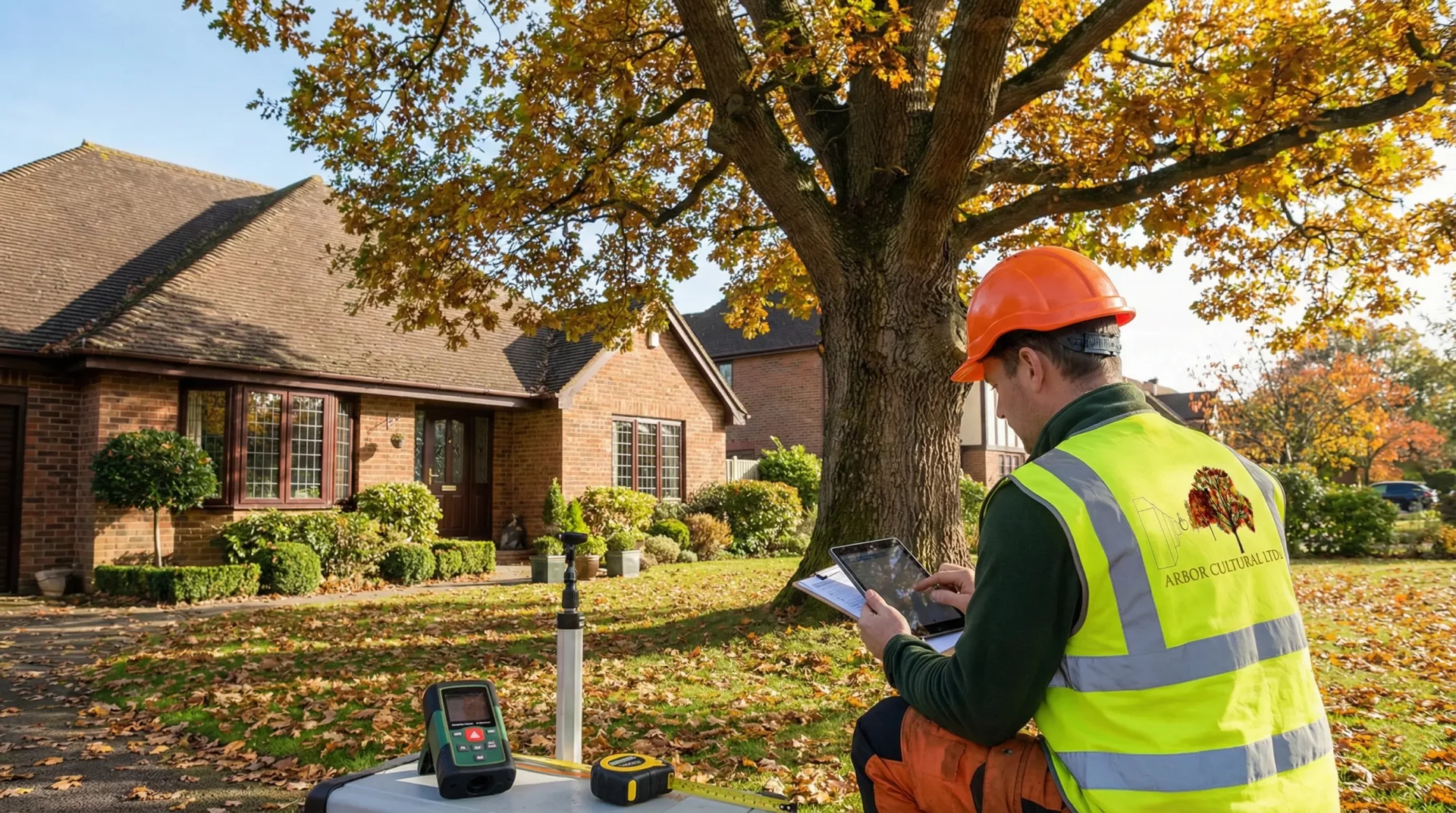
Turns commitments into instructions
The statement can convert approved arboricultural principles into a clear sequence that contractors can understand and implement.
Need an Arboricultural Method Statement for a planning condition or works near retained trees? Send the condition and drawings you already have and we’ll help identify the right scope.
FREE · NO OBLIGATION
Tell us where the site is. A consultant will review the planning condition, drawings and project information and email a fixed-fee proposal for the appropriate AMS scope.
Our team will review your project and reply to . If we need more information to prepare your quote, we’ll get in touch.
This is a request for a quote; your instruction is confirmed once the scope and fee are agreed.
Prefer to talk?
0204 531 6444
Or
email your condition and drawings
.
20+ yearsArboricultural experience
Independent adviceProject-specific methodology
Fixed-fee proposalScope agreed before instruction
An Arboricultural Method Statement (AMS) explains how demolition or construction work will be carried out where retained trees need protection. It turns the approved arboricultural strategy into practical site instructions for operations such as access, excavation, services, surfacing, fencing and supervised work.
Use the form above or email the exact condition wording and latest drawings. You do not need to work out whether the project also needs a Tree Protection Plan or supervision before getting in touch.
An Arboricultural Method Statement, often shortened to AMS, is a project-specific document explaining how relevant demolition and construction operations will be carried out where retained trees need to be protected.
The statement can convert approved arboricultural principles into a clear sequence that contractors can understand and implement.
Fencing, ground protection, demolition, excavation, services, surfacing, access, storage and supervised works can all be addressed where relevant.
Where permission requires an AMS or related tree-protection information, the document can form part of the material submitted to address that condition.
An AMS may be requested with an application, as part of a detailed BS5837 package, or after permission through a planning condition. The trigger depends on the retained trees, site constraints, design and exact wording issued for the project.
A decision notice may require detailed protection or methodology to be approved before the relevant works begin.
Excavation, surfacing, foundations or access close to retained trees may need a clearly described and coordinated method.
Routes and installation methods may need arboricultural coordination where root disturbance is a material concern.
Some works may require consultant attendance, records or hold points where arboricultural judgement is needed on site.
If permission contains a pre-commencement condition requiring written approval, that condition must be dealt with through the appropriate planning route before works governed by it commence.
These documents do different jobs. The correct combination depends on the project and planning stage, so an AMS should not simply duplicate an earlier report.
Records the relevant trees and the arboricultural context of the site.
Explains the relationship between the proposed design and retained, removed or affected trees.
Shows where barriers, exclusion areas and other protection measures are located.
Explains how relevant operations are to be undertaken near retained trees.
Provides consultant attendance or records where required by the agreed strategy.
Not every project needs every item below. The AMS should be proportionate and site-specific, covering the operations that genuinely interact with retained trees and the planning requirements.
Barrier locations, sequencing, controlled access and any restrictions on when protection can be altered.
Measures for protecting soil and rooting areas where pedestrian, plant or vehicle movement is proposed.
Controlled demolition, slab removal, foundation removal and access where retained trees are close to the work.
Hand excavation, supervised excavation, root discovery procedures and limits on mechanical excavation where relevant.
Preferred routes, trenching controls and coordination with project designers where services pass close to retained trees.
Arboricultural principles for reduced-dig or no-dig surfacing where such an approach is part of the accepted design.
Relevant arboricultural controls around foundations, piles or other construction elements where the approved design needs them.
Restrictions on materials, washout, plant movement, temporary compounds and activities that could damage rooting areas.
Operations requiring consultant attendance, notification, photographs or records before the next work stage proceeds.
The RPA is an arboricultural planning tool. The Construction Exclusion Zone is the practical area intended to be protected from unauthorised construction activity. A project-specific AMS should explain how the approved strategy is implemented on the ground.
The RPA helps inform the minimum rooting area that should be considered when designing and planning works around retained trees. Site-specific conditions, actual root distribution and the approved development context remain important.
The CEZ is the area to be protected from unauthorised activity during works. It may be defined by barriers, ground protection, controlled access or other measures shown in the approved strategy.
The correct method depends on the tree, site, approved design and engineering requirements. An AMS should coordinate arboricultural controls with the relevant design disciplines rather than pretending to replace them.
| Operation | Arboricultural concern | What the AMS may need to define | Other coordination |
|---|---|---|---|
| DemolitionStructures close to trees | Root, stem or crown damage during removal. | Sequence, access, machinery position and supervised limits. | Demolition contractor and structural requirements. |
| ExcavationWork in or near RPAs | Root severance and soil disturbance. | Hand-dig or controlled excavation method, root discovery protocol and supervision. | Engineer, contractor and approved design. |
| Drainage & utilitiesTrenches and service routes | Linear excavation can intercept significant roots. | Preferred routes, controlled methods and hold points. | Drainage, utility and civil design. |
| Hard surfacingDriveways, paths and parking | Excavation, compaction and changes to soil conditions. | Reduced-dig/no-dig principles, edge details and construction sequence where appropriate. | Pavement and engineering design. |
| FoundationsBuilding elements close to trees | Excavation and root loss. | Arboricultural limits, supervised operations and tree-protection sequencing. | Structural and geotechnical design. |
| Temporary accessPlant and deliveries | Soil compaction and physical damage. | Route, ground protection, loading restrictions and duration. | Site logistics and contractor management. |
The safest starting point is the exact decision notice or planning request. Small differences in wording can change whether information is required before commencement, before demolition, before a particular operation or as part of a wider discharge package.
The AMS may form part of the information that needs written approval before works governed by the condition commence.
The condition may specify timing, inspection, photographs or approval of tree-protection measures before demolition or construction.
Excavation, surfacing, services, foundations or access can require more detail where they interact with retained trees.
The condition or approved AMS may identify hold points where arboricultural supervision or records are required.
If the contractor wants to move fencing, reroute services or change a method, check whether arboricultural or planning approval is required before implementation.
Where an Arboricultural Method Statement is required by condition, the submission should respond to the wording actually imposed. It may also need a Tree Protection Plan, supervision details or other supporting information.
Identify the trigger, documents requested, approval mechanism and any specific construction or supervision requirements.
Make sure the AMS and TPP relate to the current approved scheme rather than a superseded design revision.
Set out the protection, sequence, methods and supervision relevant to the actual construction operations.
The written method and Tree Protection Plan should use consistent revisions, labels and protection terminology.
The project team or planning agent can submit the required information in accordance with the permission and authority process.
The approved documents should then be issued to the contractor and incorporated into construction planning.
Arboricultural methodology should coordinate with the project team. It does not replace engineering, architectural, drainage, demolition or contractor design responsibilities.
Defines arboricultural constraints, site-specific protection principles, sensitive-operation requirements and supervision where relevant.
Coordinates the approved development layout and revisions with the arboricultural information and wider design team.
Provides the structural, drainage, pavement, utility or geotechnical design required for the relevant construction element.
Briefs the site team, follows the approved sequence and protection measures, and raises proposed variations before they are implemented.
Supervision can be useful where the planning condition, approved AMS or sensitive operation requires arboricultural judgement on site. The exact attendance should be proportionate to the risk and agreed scope.
Check that fencing, exclusion areas or ground protection are in the intended position before the relevant construction stage begins.
Attend operations where roots may be encountered and the approved method requires arboricultural input or a defined hold point.
Photographs or concise supervision records can document what was observed and the advice provided during the agreed attendance.
Tree Preservation Orders, conservation-area controls and planning conditions are separate considerations. An AMS should work within the approved planning position rather than being treated as permission for unrelated tree work.
Where retained trees are protected, proposed work to the trees themselves may require a separate application, notice or other planning route depending on the circumstances. The AMS is concerned with implementing the development methodology around those trees.
If development has already been permitted, follow the decision notice, approved plans and any arboricultural conditions. Proposed variations should be checked before site teams depart from the approved strategy.
A method statement should be usable by the contractor and consistent with the planning permission. Generic wording and outdated drawings are common reasons a technically plausible document becomes difficult to implement.
A method that does not refer to the actual layout, operations and tree constraints gives the site team little useful direction.
Protection and methodology based on superseded plans can conflict with the approved construction layout.
A strong PDF is ineffective if demolition, groundwork and site-management teams never see or understand it.
If sensitive work needs consultant attendance, the programme should identify when notice is required and what activity is being observed.
Late service routes can introduce new excavation within tree-sensitive areas even when the building layout itself is acceptable.
Moving fencing, access or working methods without checking the arboricultural and planning implications can undermine the approved strategy.
Use the form above or email the decision notice, approved plans, existing tree information and contractor questions.
The condition, design, existing BS5837 information and likely construction interactions are reviewed before the scope is confirmed.
The agreed AMS and any related Tree Protection Plan or supporting information are prepared around the actual project.
Where required, the work can continue into arboricultural supervision, site records or advice on proposed construction-stage variations.
The same AMS template should not be applied to every site. These examples show why the methodology needs to follow the actual conflict and construction sequence.
The method may need to address excavation limits, ground protection, surface build-up, edge restraint, levels and the order in which protection is removed or replaced.
Tree-sensitive sections may require route changes, controlled excavation, supervised work or coordination with the drainage designer before the trench is opened.
Plant location, pull direction, slab removal and access can all matter where demolition activity sits close to the stem or rooting area.
The arboricultural method should coordinate with the engineer’s design and define the tree-protection sequence, excavation controls and any supervision required by the approved strategy.
A technically correct report can still fail operationally if the people carrying out the works do not know which document is current, where the protection sits or which activities need arboricultural attendance.
Superseded revisions should be removed from circulation so contractors are not following conflicting protection layouts.
Tree restrictions should be understood before demolition, excavators, deliveries and temporary compounds arrive.
Hold points should be planned rather than discovered on the morning the work is due to start.
Groundworkers, drainage teams, landscapers, utility installers and demolition crews can all affect retained trees.
Check the arboricultural and planning implications before moving fencing, rerouting services or changing a construction method.
A short Arbor Cultural briefing on turning planning requirements into construction-stage instructions for protecting retained trees around demolition, access, excavation, services and building work.
Send the exact planning-condition wording and the latest approved drawings. That makes it easier to determine whether the project needs an AMS alone or a wider package including a TPP or supervision.
A simple AMS using reliable existing tree information is different from a constrained construction site needing revised protection drawings, service coordination, complex methodology and multiple supervised operations.
Start with what you already have. The condition and approved drawings are usually more useful than trying to describe the requirement from memory.
The existing page already carries the live Trustindex badge above, so this section does not load a second review widget. Use the independent Trustindex profile to read the wider published client feedback.
Arbor Cultural supports AMS, Tree Protection Plan and construction-stage arboricultural work across Greater London, Surrey, West Sussex, East Sussex, Kent, Hampshire, Berkshire, Buckinghamshire and Oxfordshire. Select a region to see the named locations represented in the current service coverage.
Basements, demolition, access, neighbouring trees and close construction relationships can create detailed methodology requirements.
Mature trees, access changes, hard landscape and Green Belt or village settings can create practical tree-protection considerations.
Projects can require detailed protection, drainage, access or supervision methods as they move from permission into construction.
Levels, retaining structures, access and mature trees can make buildability around retained trees an important AMS issue.
Construction-stage arboricultural requirements can range from simple protection setup to complex controlled operations.
AMS work can continue into implementation where sensitive excavation or protection measures need arboricultural input.
Mature tree stock and tight layouts can require careful coordination between the AMS, TPP and construction design.
Access, services and construction methodology may all need to reflect the approved tree-retention strategy.
Project-specific methodology can help translate planning-stage tree commitments into practical construction controls.
If you have a planning condition, decision notice, approved drawing or contractor query, send the wording exactly as issued. You do not need to translate it into arboricultural terminology first.
An AMS is a site-specific document describing how relevant demolition and construction operations will be carried out while protecting retained trees and implementing the agreed arboricultural strategy.
It may be requested with a planning application or through a planning condition, particularly where development is close to retained trees and the planning authority needs detail on protection, access, excavation, surfacing, services, supervision or other construction operations.
No. The Tree Protection Plan is primarily the spatial drawing showing protection and controlled working areas. The AMS explains how relevant operations are to be undertaken. They are often used together.
Yes, where an AMS is among the information required by the condition. The submission must still respond to the exact condition wording and may also need a TPP, supervision details or other information.
Not necessarily. If the permission contains a pre-commencement condition requiring written approval from the Local Planning Authority, the relevant condition must be dealt with in accordance with the permission before works governed by that condition commence.
Not always. If reliable, sufficiently current BS5837 information and approved planning documents already exist, they may provide the necessary baseline. If site conditions, trees or proposals have materially changed, further survey or updated information may be appropriate.
It is the area intended to be protected from unauthorised construction activity around retained trees. The approved strategy may use protective fencing, ground protection or other controls to define and manage it.
Sometimes a planning-approved design requires controlled operations within or close to an RPA. Whether that is acceptable depends on the tree, site, extent of encroachment, proposed method and planning context. The AMS can set out the site-specific method where such work has been accepted in principle.
It can. Where reduced-dig or no-dig surfacing is appropriate, the AMS can explain the arboricultural principles, sequence and protection requirements. Engineering design should still be provided by the relevant designer where needed.
Service routes can be a major source of root disturbance. The AMS may identify preferred routes and controlled methods, but drainage and utility design should be coordinated with the relevant project professionals.
Supervision may be specified by the planning condition, approved AMS or TPP, or recommended for operations where arboricultural judgement is needed on site. Typical examples can include sensitive excavation, barrier changes or work close to important roots.
Yes, but the planning implications of the change need to be understood first. A materially changed design may require updated arboricultural assessment, revised protection information or further approval rather than simply editing the wording of the original AMS.
Timescale depends on the condition, available drawings, whether an existing survey/TPP can be relied on, site complexity and whether further site work is needed. Your fixed-fee proposal can confirm the expected programme for the specific instruction.
At minimum, the principal contractor or site manager should understand the tree-protection requirements relevant to the works. Sensitive requirements should also be communicated to affected subcontractors such as demolition, groundwork, drainage, utility and landscaping teams.
They are often issued together because the TPP shows where protection and controlled areas are located while the AMS explains the method. Whether they are separate documents or combined within one report is less important than clear cross-referencing and consistent revision control.
Only in accordance with the approved planning/tree-protection strategy. If the AMS or condition requires arboricultural or Local Planning Authority agreement before a change, that agreement should be obtained through the appropriate route before the barrier is moved.
The response depends on root size, location, tree significance, the approved method and the purpose of the excavation. This is exactly why some operations are identified as arboricultural hold points rather than left to an unplanned decision by the groundworker.
Yes, where hand excavation is appropriate to the operation and planning strategy. However, the method should be proportionate and site-specific; “hand dig everything inside the RPA” is not automatically the correct response to every project.
It can address the arboricultural constraints, access, excavation limits and protection requirements associated with the foundation strategy. The structural design and calculations for piled foundations remain the responsibility of the appropriate engineer.
Yes. The arboricultural document can set out the principles, sequencing and tree-protection requirements for a reduced-dig or no-dig surface. Loading, pavement design and detailed engineering may still require specialist design input.
The arboricultural implications should be checked before the new route is excavated. A route that moves into an RPA may require an alternative method, updated drawing, supervision or further planning approval depending on the approved documents and condition wording.
They can be. Signs attached to protective barriers can help communicate that an area is a protected tree zone and should not be entered, altered or used for storage without authorisation. They are a communication aid rather than a substitute for correctly installed physical protection.
Where relevant, yes. Tree protection is not limited to root severance. Storage, soil compaction, contamination, washout, fires and changes in site use can all be relevant to retained-tree protection.
Potentially, yes. If a project has changed hands or the council has raised comments, send the existing AMS, Tree Protection Plan, decision notice and latest drawings so the required review can be scoped properly.
Sometimes arboricultural evidence can help explain a current site situation, but an AMS cannot retrospectively undo damage or automatically regularise a planning breach. The appropriate response depends on what has happened, the planning status and what the Local Planning Authority requires.
Yes. Arbor Cultural provides arboricultural planning and construction-stage consultancy across those areas and the wider South East. Send the site postcode if you want us to confirm coverage.
Use the form above or email the decision notice and drawings you already have. Arbor Cultural can review the likely professional scope before you instruct.
No obligation · Consultant reviewed · London & South East