Are you looking for a BS5837 tree protection plan (TPP) to enable you to get planning permission for your proposed project?
A professional Tree Protection Plan is a mandatory technical requirement for any development in Surrey, London, or the Southeast where trees are present on or adjacent to the site. This document serves as the visual roadmap for your contractors, functioning as a blueprint to prevent accidental tree damage during the build phase. Ideally, this would be used as part of the design process to work around the trees where possible and retain the important ones. The local authority tree officer may require the information as part of your submission, or alternatively may have requested the information as a Pre-Commencement Condition. Arbor Cultural Ltd provides the technical expertise to secure your instruction and Finish the Build.
Whether you are a developer, architect or planning consultant with multiple large sites, a builder with small to large sites on the go, or an individual householder organising and project managing your own extension works—we are able to assist you in all of these situations for you to achieve your goal.
The Tree Protection Plan (TPP) develops from a comprehensive suite of technical data, including the BS 5837 tree report, BS 5837 Tree Constraints Plan (TCP), and the BS 5837 Arboricultural Impact Assessment. This will then identify the issues to be addressed on the BS 5837 Tree Protection Plan (TPP), and measures to be addressed with the BS 5837 Arboricultural Supervision and any necessary Tree Replacement Planting.
The main constraints will be the stem diameter, crown spread, and crown height. These measurements establish the Root Protection Area (RPA), which is calculated directly from the stem diameter. It is also important to record the condition, category, and hazards, work recommendations, their life expectancy, and crown spread to the four cardinal points. We establish the direction of the lowest significant branch, current and expected maximum height, life stage, physical and structural condition, and the theoretical RPA.
All tree work recommendations provided by Arbor Cultural Ltd comply strictly with the British Standard BS3998 Tree Work – Recommendations (2010), unless otherwise specified in a report, with a clear justification for any deviation from the standard. We ensure your documentation is technically defensible and compliant with current planning laws.
These constraints can then be transferred from the TCP to the TPP, to show these visually, in 2D, on a Computer Aided Design (CAD) system. We use KeyTree and AutoCAD for precision mapping. In the future with Digital Arboriculture and Building Information Technology (BIM), this will be possible in 3D and 4D, representing complex site changes over time.
Our TPPs show exactly where site access and vehicle access will be directed, and where the site offices and facilities, storage of equipment and materials, and vehicles will be located. We define the physical protection measures, including tree protection fencing (Heras or alternatives) as well as ground protection measures to prevent soil compaction.
Trees have significant heritage value. This is being increasingly eroded as many large and medium-sized trees are being removed as they become unsafe or are simply in the way of proposed development or infrastructure. Additionally, there is a substantial body of research that supports the economic, environmental, and social benefits that trees bring to urban areas and the contributions that they make to people’s quality of life and sense of wellbeing.
Where trees are planted to replace those removed, often they are not given the correct conditions or management they require to enable them to reach maturity. Tree planting should be undertaken in accordance with the British Standard BS8545 Young Trees: From Nursery to Independence in the Landscape (2014). Frequently trees of a smaller final size are selected, which will not provide anything like the same amount of benefits. Arbor Cultural Ltd advocates for strategic, long-term planting that restores the environmental value of your site.
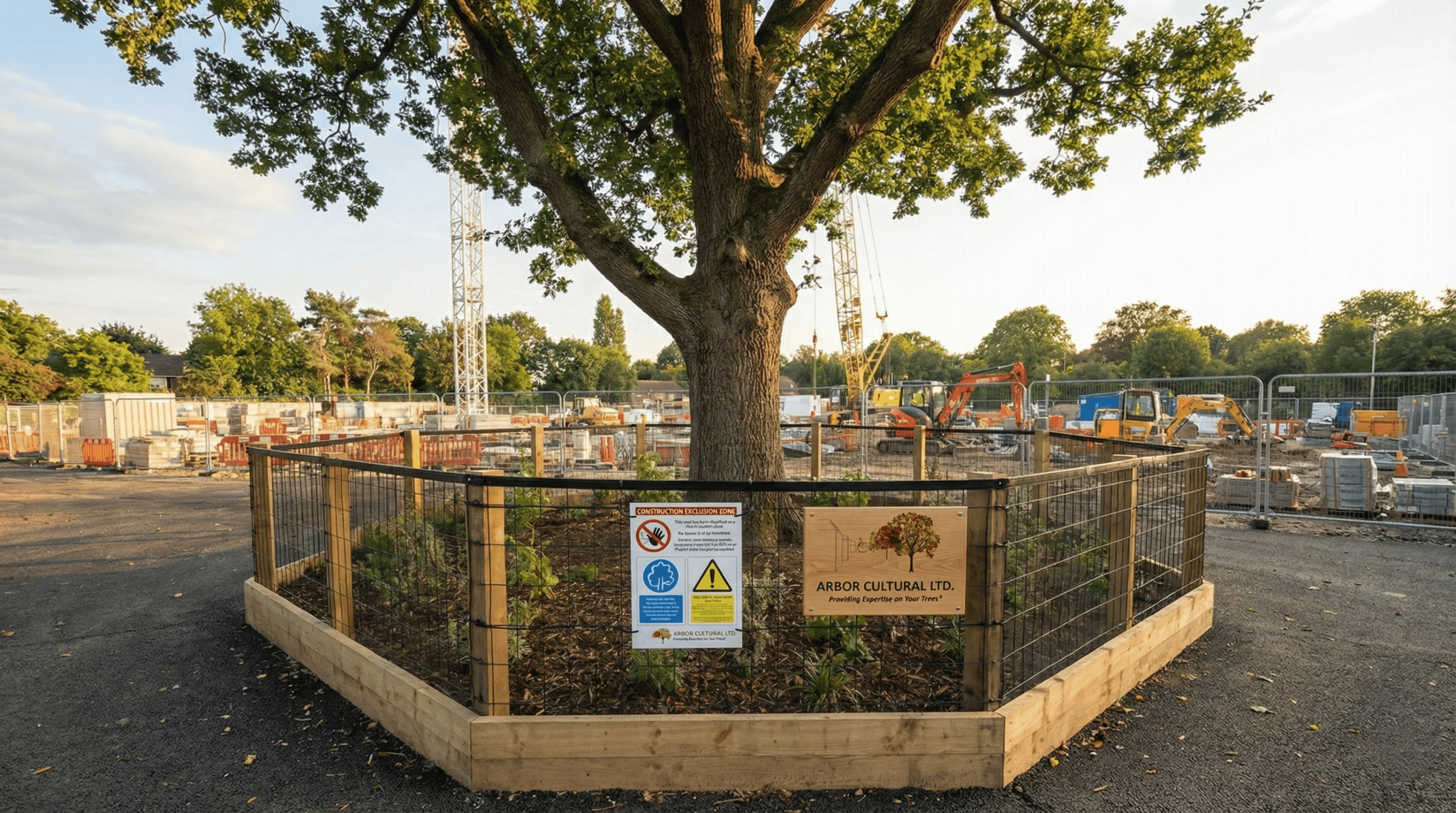
A TPP must be practical. Also, site features and layout that will have restricted or impacted on the RPA of the trees shall be recorded on the TPP. It is not only important to show the tree constraints for all the trees on or adjacent to the site, and the tree protection measures to protect them; it is essential to show how your construction site will function in reality. We identify and show any “no-dig” areas and “hand-dig” areas on these plans to ensure root integrity is maintained throughout the construction phase.
All plans produced by Arbor Cultural Ltd are to scale, with the scale and paper size recorded on all versions along with the north arrow and a suitable technical key. By providing clear, visual, and legally defensible plans, we reduce site friction and ensure your project stays on schedule and on budget.
The BSI Standards Development Committee is currently reviewing future recommendations for trees in relation to construction. At Arbor Cultural Ltd, we keep our clients ahead of these regulatory shifts, ensuring that your Tree Protection Plan remains compliant with the most recent technical committee recommendations for design, demolition, and construction.

Contact us via our simple form or by phone. We assess your specific needs and provide a fixed-fee proposal with zero hidden costs.

We arrange a visit at your convenience. Our consultants use advanced decay detection technology to gather precise data efficiently.

We produce a legally defensible report, delivered digitally—ready for immediate submission to your council or lender.