Cross-sectional evidence
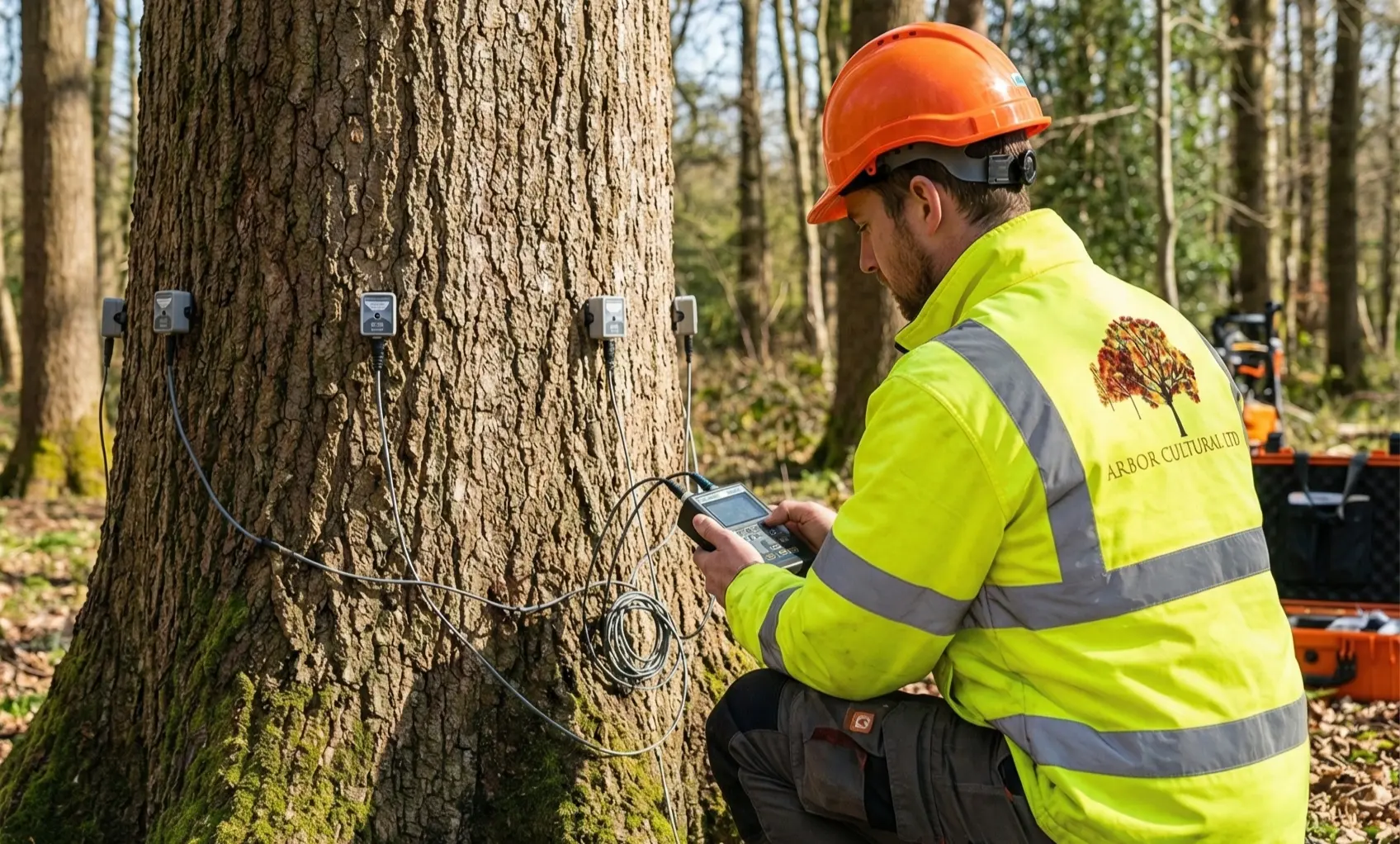
The acoustic test investigates a chosen stem cross-section without drilling a test path through the wood.
Specialist investigation for trees where visual inspection leaves an important question about internal decay, cavities, structural wood or root condition.
FREE · NO OBLIGATION
Tell us about the tree, the concern and any existing survey or recommendation. A consultant will review the information and help identify whether sonic tomography, Resistograph testing, root investigation or another approach is appropriate.
Our team will review your project and reply to . If we need more information to prepare your quote, we’ll get in touch.
This is a request for a quote; your instruction is confirmed once the scope and fee are agreed.
Prefer to talk?
0204 531 6444
Or
email your existing report and tree photos
.
Tree decay detection is a specialist arboricultural investigation used when a competent visual inspection identifies an important structural question that cannot be resolved by sight alone. The right method may be sonic tomography, resistance micro-drilling, controlled root investigation or another proportionate technique. The instrument provides evidence; the consultant still has to interpret what that evidence means for the whole tree.
Strong diagnostic work starts with the defect and the decision. That avoids unnecessary testing and over-confident conclusions.
A fungal feature may indicate a decay process, but significance depends on identity, host, location, extent and tree response.
A cavity may look dramatic while substantial functional wood remains. Testing can help describe the internal cross-section more objectively.
Where the visible defect does not reveal internal condition, targeted diagnostics can add useful evidence.
A failure history can justify closer investigation when the remaining structure or similar unions are uncertain.
More detailed evidence can be worthwhile where unnecessary removal would be significant or failure consequences are substantial.
They are not interchangeable. Each method measures a different part of the tree or answers a different type of question.
| Method | Best used for | What it measures / reveals | Key limitation |
|---|---|---|---|
| Visual tree assessment | First-line assessment | Visible tree form, cavities, fungal features, response growth, defects and site context. | Cannot directly show hidden internal wood condition. |
| Arbotom sonic tomography | Cross-sectional acoustic investigation | Relative stress-wave / sound-transmission behaviour around the tested cross-section. | The colour image is not a literal photograph of decay and still needs expert interpretation. |
| Resistograph testing | Targeted micro-drilling | Changes in drilling resistance along a selected path through the wood. | Samples a line rather than mapping the whole cross-section and is minimally invasive. |
| Air Spade root investigation | Below-ground inspection | Root collar, structural roots and soil/root relationships after controlled soil removal. | An excavation and inspection method, not an internal stem scan. |
| Tree vitality testing | Physiological assessment | Evidence about physiological performance or stress where that matters to management. | Vitality is not the same as structural stability. |
Sensors are positioned around the test cross-section and stress-wave travel times are measured between points. Software converts those measurements into a colour-coded image. Reduced transmission may be associated with decay, cavities, cracks or other structural features, so setup and interpretation matter.
The acoustic test investigates a chosen stem cross-section without drilling a test path through the wood.
Accurate geometry and sensor position are important because irregular stems and poor setup can distort interpretation.
A tomogram represents the chosen cross-section, not the entire tree. Test levels should relate to the actual defect.
Low-velocity zones should be interpreted with visual findings and tree geometry rather than translated directly into “safe” or “unsafe”.
Where positions and geometry are documented carefully, repeat tests can sometimes compare change over time.
A targeted resistance drill can sometimes investigate a specific zone highlighted by the acoustic assessment.
A Resistograph records resistance as a fine drilling needle passes through the wood. The trace can help investigate changes in wood condition, cavities or residual functional wood along that exact path.
The drilling path should be selected from the defect, visual assessment or another diagnostic result — not chosen arbitrarily.
Changes in resistance are interpreted with species, growth characteristics, drilling position and other observations.
A resistance drill tells you about the chosen path. It cannot by itself describe the whole circumference or full three-dimensional extent of a defect.
Because the method is minimally invasive, testing should be proportionate and focused on a question that matters.
The tree, defect, targets, instruction and reason testing was proportionate should be clear.
Visible defects, fungal features, cavities, unions, adaptive growth and site conditions are considered alongside data.
The method, test level and scope should be clear enough to understand what the diagnostic output represents.
Relevant outputs can be included so the interpretation is linked to the underlying evidence.
The consultant explains significance and limitations rather than presenting a colour image without context.
Options can include retention, monitoring, repeat testing, further investigation, pruning or removal where justified.
Trees are living structures exposed to changing weather, growth and site conditions. Advanced diagnostics can improve the evidence available, but the conclusion remains professional judgement with stated limitations.
Useful where a mature tree has a cavity, fungus or defect and the owner wants evidence before major work.
Advanced testing can follow a competent survey where a significant tree in a high-use location needs closer investigation.
Diagnostic evidence can help resolve whether an important tree is realistically retainable and inform design.
Detailed evidence can help when a visible defect is material to a management or planning decision.
Testing can be scoped as a specialist component within another arboricultural consultant wider assessment.
Where tree condition is disputed or consequential, diagnostic data may support a wider professional evidence package.
Advanced decay detection is most defensible when a competent inspection identifies a specific uncertainty that could materially affect the management decision.
Most trees do not need advanced diagnostics simply because they are mature or large.
The test should connect directly to a cavity, fungus, wound, union, failure history or another specific concern.
The report should explain why the test was selected, what it found, its limitations and how it informed the recommendation.
Useful external references: HSE landowner guidance · GOV.UK urban-tree management guidance.
Provide the site address, photographs and any existing survey, tree officer request, insurer wording or planning/TPO correspondence.
We identify the actual uncertainty and whether advanced testing is likely to add useful evidence before recommending a method.
The consultant assesses the tree, defect, fungal features, targets and surrounding context before interpreting diagnostic data.
Sonic tomography, Resistograph testing, Air Spade investigation or another proportionate method is carried out where justified.
Instrument outputs are considered with species, geometry, visible defects, adaptive growth, site exposure and management history.
The report explains findings, limitations and proportionate options such as retention, monitoring, further investigation, pruning or removal where justified.
The fee depends on the actual diagnostic question rather than a generic “scan” price. Arbor Cultural reviews the tree, access, method and reporting requirement and provides a fixed-fee proposal before instruction.
Number of trees: one suspect tree is different from a programme across an estate.
Tree size and geometry: large, irregular or multi-stemmed trees can require more setup and interpretation.
Number of test levels: one cross-section does not describe the whole tree.
Method: tomography, resistance drilling, root exposure and vitality work are different services.
Access: elevated defects or restricted sites can change the scope.
Reporting: a concise diagnostic report and a detailed planning, TPO or legal evidence report are not equivalent.
Send the site postcode, whole-tree photographs, close-ups of the defect and any existing arboricultural report. We can then quote the method that fits the question.
Get my fixed-fee quote →| Problem | Likely starting point | Why | Service |
|---|---|---|---|
| Internal stem condition unclear | Arbotom sonic tomography | Cross-sectional acoustic evidence can map zones with different transmission. | Arbotom → |
| A specific point needs confirmation | Resistograph testing | Targeted drilling resistance investigates the selected path. | Resistograph → |
| Root collar or structural roots need exposure | Air Spade investigation | Controlled excavation allows direct inspection. | Air Spade → |
| Physiological decline / stress | Tree vitality testing | Physiological evidence addresses a different question from structural decay. | Vitality → |
| Wider question is condition and safety | Tree Health & Safety Report | A competent survey can determine whether advanced testing is needed at all. | Tree safety → |
Published feedback from clients who have instructed Arbor Cultural for tree surveys, specialist diagnostics, planning and property work.
These are service areas, not claimed office locations.
The visible FAQs are mirrored in the page structured data.
Tree decay detection is specialist arboricultural investigation used when visual inspection leaves an important question about internal wood condition, cavities, structural roots or another defect. The method should be selected to answer that specific uncertainty.
Advanced testing may help where a cavity, fungal fruiting body, wound, previous failure, unusual response growth or another feature raises a structural question that cannot be resolved confidently by visual assessment alone.
No. A cavity does not automatically mean advanced testing is necessary. The first step is to assess the tree, defect, target and management decision, then choose further testing only if it is likely to add useful evidence.
Sonic tomography is a non-invasive diagnostic method that measures stress-wave travel between sensors positioned around a tree stem or branch. Software uses those measurements to construct a cross-sectional image of zones with different sound-transmission characteristics.
Arbotom tomography measures how stress waves travel through the tested cross-section. Reduced transmission can be associated with decay, cavities, cracks or other structural features, so the tomogram is evidence to interpret rather than a literal photograph of decay.
No. Colour zones represent the software interpretation of sound-transmission behaviour. Management decisions must consider the whole tree, residual functional wood, defect geometry, targets, species, loading and adaptive growth.
The acoustic tomography stage is generally treated as non-invasive because the diagnostic assessment does not require drilling a test path through the cross-section. Correct sensor attachment and measurement are still important.
No diagnostic method detects every defect equally well. Geometry, cracks, cavities, species characteristics, test height and sensor layout can affect interpretation. Testing should be selected and interpreted by an experienced consultant.
Yes, repeat testing can sometimes help monitor change over time, provided the test level, geometry and measurement positions are documented carefully enough to make comparison meaningful.
Resistograph testing uses a fine drilling needle to record changes in resistance as it passes through wood. The trace can help investigate decay, cavities and changes in wood condition along that particular drilling line.
It is minimally invasive because a fine needle penetrates the wood. The number and position of drilling paths should therefore be targeted to the question being investigated rather than used indiscriminately.
Sonic tomography assesses a cross-section through acoustic measurements, while a Resistograph gives detailed information along selected drilling paths. They answer different questions and can sometimes be used together.
No. The diagnostic method should match the defect and management question. Some trees may need only one method, while others may benefit from complementary testing.
Residual wall thickness describes remaining sound or mechanically functional wood around a cavity or degraded zone. It can be useful, but it should not be treated as a universal pass/fail number for every tree.
No test can guarantee that a living tree will never fail. Diagnostic testing reduces uncertainty and supports a professional management decision within the limitations of the method and inspection.
Testing can identify or help quantify structural concerns, but the conclusion still depends on the defect, tree form, target, exposure, adaptive growth and other evidence.
Some fungal fruiting bodies can be associated with wood decay, but significance depends on fungal identity, host species, location and tree condition. Fungal presence can be a reason for closer assessment rather than a conclusion by itself.
Fungal features observed during inspection can be recorded and interpreted within the arboricultural assessment. Where identification is uncertain or critical, more specialist mycological input may be appropriate.
A visual tree assessment examines form, crown, stem, unions, root collar, visible defects, fungal features and site context. It is normally the starting point before advanced diagnostic testing is considered.
The instrument does not decide where to test or what the result means. Visual assessment identifies the defect, relevant test plane and management question the diagnostic method is intended to answer.
Yes. Better information can sometimes show that a tree with an alarming external feature still has enough functional structure for retention or proportionate management rather than precautionary removal.
Yes, where combined evidence shows the defect is significant and the risk cannot be managed acceptably by retention, monitoring or proportionate work. The recommendation should follow the evidence.
Potentially. Where a protected tree has a disputed structural defect, diagnostic evidence can help explain internal condition and support the arboricultural reasoning behind proposed work. The Local Planning Authority still determines the application.
Yes. Specialist evidence can support professional advice where tree condition is relevant, but the statutory notice or TPO process still needs to be followed where applicable.
Yes. On development sites, diagnostic testing can help resolve uncertainty about the condition and realistic retention of important trees, improving evidence available to the design team and planning authority.
Sometimes. If a property report identifies a genuine structural tree concern that cannot be resolved visually, targeted diagnostic testing may add evidence. It should not be added automatically to every property instruction.
Yes. Schools, estates, hospitals, commercial sites and other duty holders may commission specialist testing for significant trees where a visual inspection has identified a defect needing closer investigation.
Tree owners and duty holders are generally expected to take reasonable care in managing foreseeable risks from trees. The standard is not a guarantee of absolute safety; proportionate inspection and action are important.
No. Proportionate tree risk management does not mean advanced testing every tree. Specialist diagnostics are appropriate where competent inspection identifies a specific uncertainty that matters to the management decision.
Air Spade investigation uses compressed air to move soil from around roots with less mechanical disturbance than conventional excavation. It can help expose root collars, structural roots or soil/root relationships where below-ground investigation is justified.
No. It is a method of exposing soil and roots for direct inspection. It can complement structural assessment where root condition or root-collar defects need to be seen.
Tree vitality testing provides physiological information about how a tree is functioning. It addresses a different question from structural decay testing and should be used where physiological condition matters to management.
No. A vigorous tree can still have a structural defect, and a physiologically stressed tree is not automatically unsafe. Structural condition and physiological condition are distinct.
Yes, subject to the site, defect and appropriate method. Diagnostic evidence can be particularly valuable where a high-value tree has heritage or amenity significance and unnecessary removal should be avoided.
Yes, where the chosen equipment and sensor configuration are suitable. Larger or irregular stems may require careful measurement, sensor placement and interpretation.
Some diagnostic techniques can be used at branches, unions or other accessible parts of a tree where the defect and safe working method justify it. The scope should be agreed from the actual concern.
The agreed output can include site observations, photographs, diagnostic plots or tomograms, interpretation, limitations and management recommendations. Report format depends on the client and purpose.
Where those methods are used and the reporting scope includes them, relevant diagnostic outputs can be included or referenced so the conclusion is linked to the underlying evidence.
Fees depend on tree numbers, diagnostic method, tree size, access, testing locations, reporting needs and whether specialist access or additional methods are required. Arbor Cultural provides a fixed-fee proposal after reviewing the scope.
Site time varies with tree size, geometry, number of test levels and diagnostic method. Reporting time also depends on complexity of interpretation. Include any genuine deadline with the enquiry.
Send the site address or postcode, clear photographs of the whole tree and area of concern, any existing tree report or council request, and explain what decision the testing needs to support.
Not always. However, if another arboriculturist has recommended advanced testing, sending that report is very useful because it explains the defect and question the diagnostic work is intended to answer.
Specialist diagnostic work can be scoped as a technical input to another consultant wider instruction where roles, reporting and interpretation are agreed clearly.
Arbor Cultural provides expert arboricultural services. Where decay testing forms part of a legal or disputed matter, the scope and evidential requirements should be agreed specifically rather than treating a standard diagnostic report as expert evidence automatically.
Yes. Arbor Cultural provides tree decay detection across Greater London, Surrey, West Sussex, East Sussex, Kent, Hampshire, Berkshire, Buckinghamshire and Oxfordshire, subject to project scope.
Send photographs, the site postcode and any existing report. A consultant can help identify whether advanced testing is likely to add useful evidence and provide a fixed-fee proposal.
Start my decay detection quote →Email my tree photos