Extension or replacement dwelling near trees
Survey information can identify Root Protection Areas and crown constraints before the footprint and access arrangements are fixed.
BS5837 planning support · Epsom and Ewell
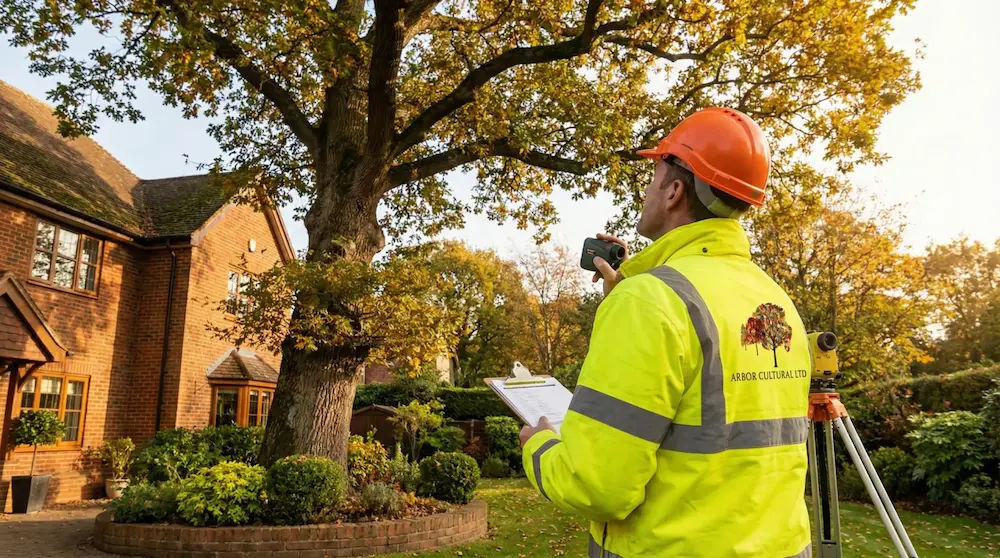
Qualified Arbor Cultural consultants provide BS5837 tree surveys, arboricultural impact assessments and planning reports for development projects across Epsom and Ewell. The page is built around the current local authority guidance, the real planning-document chain and direct professional consultancy rather than generic location copy.
Send the postcode + council wording + plans if you have them. Arbor Cultural will scope the survey/report before instruction.
Council-guidance review: 31 August 2026 · Epsom and Ewell Borough Council sources are linked below.
What Epsom and Ewell Borough Council says
Epsom & Ewell states that a Tree Survey and Arboricultural Impact Statement may be required where development occurs within the root protection area of a tree, regardless of whether that tree has a Tree Preservation Order.
That makes early tree constraints work relevant to ordinary householder and development projects, not only applications involving protected trees.
The council also provides planning and protected-tree information that applicants can use to check site constraints before the design and submission are finalised.
Epsom and Ewell planning decoder
This section is intentionally specific to Epsom and Ewell rather than repeating the same town-page copy across Surrey.
Survey information can identify Root Protection Areas and crown constraints before the footprint and access arrangements are fixed.
Smaller sites often have less room to absorb tree constraints, making early survey data especially useful to the design team.
Protected-tree controls and planning-development assessment are related but separate questions; the right route depends on the proposal.
BS5837 constraints are not limited to trees within the applicant’s ownership where adjacent crowns or RPAs interact with the site.
A deeper Epsom and Ewell planning guide
This guide is written for applicants, architects and project teams working specifically in Epsom and Ewell. It expands the council-source notes above into a practical workflow without pretending every site needs the same report package.
When a project in Epsom and Ewell includes mature trees, boundary trees or neighbouring trees, the first useful step is to establish what is actually on and around the site. A BS5837 survey records the information needed to understand the arboricultural constraints. That information can then inform the proposed layout instead of being treated as an afterthought. Arbor Cultural asks for the postcode, any council wording and the plans available so the scope can be matched to the project stage. That is particularly useful where an applicant has been told only that “tree information” is required and does not yet know whether the planning team needs a survey, an impact assessment, a protection plan, a method statement or a combination of those documents.
The purpose of a planning tree survey is not simply to count trees. The schedule and drawing information give the design team a structured picture of species, size, condition, retention category, crown spread and Root Protection Areas. That evidence helps architects understand where a footprint, driveway, level change, service run, access route or construction activity may create a conflict. Where a conflict exists, the next question is whether the layout can be adjusted, whether a tree can reasonably be removed, or whether specialist construction and protection methods are needed. Using the arboricultural information while the scheme is still flexible normally creates more options than commissioning it after the design has effectively been fixed.
The official links on this page are included because the planning authority remains the source for its current validation and protected-tree requirements. The local guidance should be read alongside the specific proposal rather than converted into a blanket statement that every application needs every BS5837 document. Arbor Cultural can use the council wording supplied by the applicant to define an appropriate scope. This keeps the technical work proportionate while still giving the planning team the evidence it needs to understand retained trees, potential impacts and practical protection during demolition or construction.
In Epsom and Ewell, as elsewhere, a relevant tree can sit on neighbouring land, within a garden boundary, beside a highway or close enough to the works for its crown or rooting area to influence the design. Ownership alone does not determine whether a tree matters to a planning layout. That is why the site visit and measured relationship between trees and proposed works are important. The same principle applies across places such as Epsom, Ewell, Stoneleigh, West Ewell, Epsom Downs, Horton. A local page is useful only when it explains these practical planning relationships; it should not merely repeat a list of town names.
The survey is the evidence base. An Arboricultural Impact Assessment then explains what the proposal means for the surveyed trees: which are retained, which are removed, where incursions occur and what mitigation is proposed. A Tree Protection Plan translates the retention strategy into a drawing that can be used by the project team. An Arboricultural Method Statement goes further where the sequence or method of work needs to be controlled around retained trees. Not every project needs the full chain, but when several documents are required they should read as one coherent technical story rather than separate templates assembled at the end of the application.
A good submission should let the planner, tree officer and design team understand where the relevant trees are, their arboricultural quality, the constraints they create, the effect of the proposal and the measures used to protect retained trees. Clear drawings matter as much as prose because Root Protection Areas, canopy relationships, barriers and construction zones are spatial issues. The report should also be internally consistent with the architectural and site drawings. If the site plan changes materially, the arboricultural information may need to be reviewed so it still describes the scheme that is actually being submitted.
A directory or lead-matching page can be useful for discovering suppliers, but it does not replace the professional judgement needed on the site itself. Arbor Cultural provides the arboricultural consultancy directly. That means the same technical context can carry from the initial scope through the site survey and into any impact, protection or method-statement work that follows. For applicants in Epsom and Ewell, this is the main point of differentiation: the page is not only about finding somebody who offers a tree survey; it explains how the resulting information should help the planning and design process.
Survey information can identify Root Protection Areas and crown constraints before the footprint and access arrangements are fixed. In practical terms, the useful question is not simply whether a tree is present. The design team needs to understand how the tree, its crown, its rooting environment and the proposed works interact. That is why early survey information can be more valuable than waiting until validation or a planning condition forces the issue.
Smaller sites often have less room to absorb tree constraints, making early survey data especially useful to the design team. In practical terms, the useful question is not simply whether a tree is present. The design team needs to understand how the tree, its crown, its rooting environment and the proposed works interact. That is why early survey information can be more valuable than waiting until validation or a planning condition forces the issue.
Protected-tree controls and planning-development assessment are related but separate questions; the right route depends on the proposal. In practical terms, the useful question is not simply whether a tree is present. The design team needs to understand how the tree, its crown, its rooting environment and the proposed works interact. That is why early survey information can be more valuable than waiting until validation or a planning condition forces the issue.
BS5837 constraints are not limited to trees within the applicant’s ownership where adjacent crowns or RPAs interact with the site. In practical terms, the useful question is not simply whether a tree is present. The design team needs to understand how the tree, its crown, its rooting environment and the proposed works interact. That is why early survey information can be more valuable than waiting until validation or a planning condition forces the issue.
The BS5837 planning chain
The exact scope depends on the proposal and council request. Arbor Cultural confirms what is required before you instruct.
Tree schedule, dimensions, condition, retention category, crown spread and Root Protection Area data.
Maps the arboricultural constraints early enough for architects and designers to respond intelligently.
Explains the relationship between the proposed development, retained trees, removals and mitigation.
Sets out practical tree-protection zones and barriers for demolition and construction phases.
Details the working methods needed where construction activity interfaces with retained trees.
A clear digital report package for applicants, architects, consultants and the local planning authority.
Epsom and Ewell project briefing
The Arbor Cultural advantage
Local relevance matters, but so does who actually inspects the trees and stands behind the technical report.
Your enquiry is scoped by Arbor Cultural and the technical work is delivered as arboricultural consultancy rather than your details simply being passed to an unknown provider.
The work is built around BS5837 constraints, impact, protection and method statements — not generic tree surgery or a generic lead-generation directory.
This Epsom and Ewell page carries council-specific validation information, local scenarios, sources and FAQs so it can stand on its own as a useful planning resource.
Epsom and Ewell tree-survey FAQs
No. Epsom & Ewell refers to tree survey and arboricultural impact information where development occurs within a root protection area regardless of whether the tree is TPO-protected.
Yes. Relevant trees outside the ownership boundary can matter where their crowns or Root Protection Areas influence the proposed development.
The survey records and categorises the trees and constraints. The Arboricultural Impact Assessment evaluates the proposed design against those constraints and explains retention, removal and mitigation.
Send Arbor Cultural the council wording, postcode and available plans. The consultancy can define the correct BS5837 scope before instruction.
Surrey BS5837 council guides
These links are generated only for CVVS council pages that are currently published, helping the local pages support one another without creating links to unpublished drafts.
Direct to Arbor Cultural
Send the postcode, council wording and plans. You do not need to diagnose the report type yourself.
Arbor Cultural Ltd · Independent arboricultural consultancy · admin@arbor-cultural.co.uk