Physical growth or contact
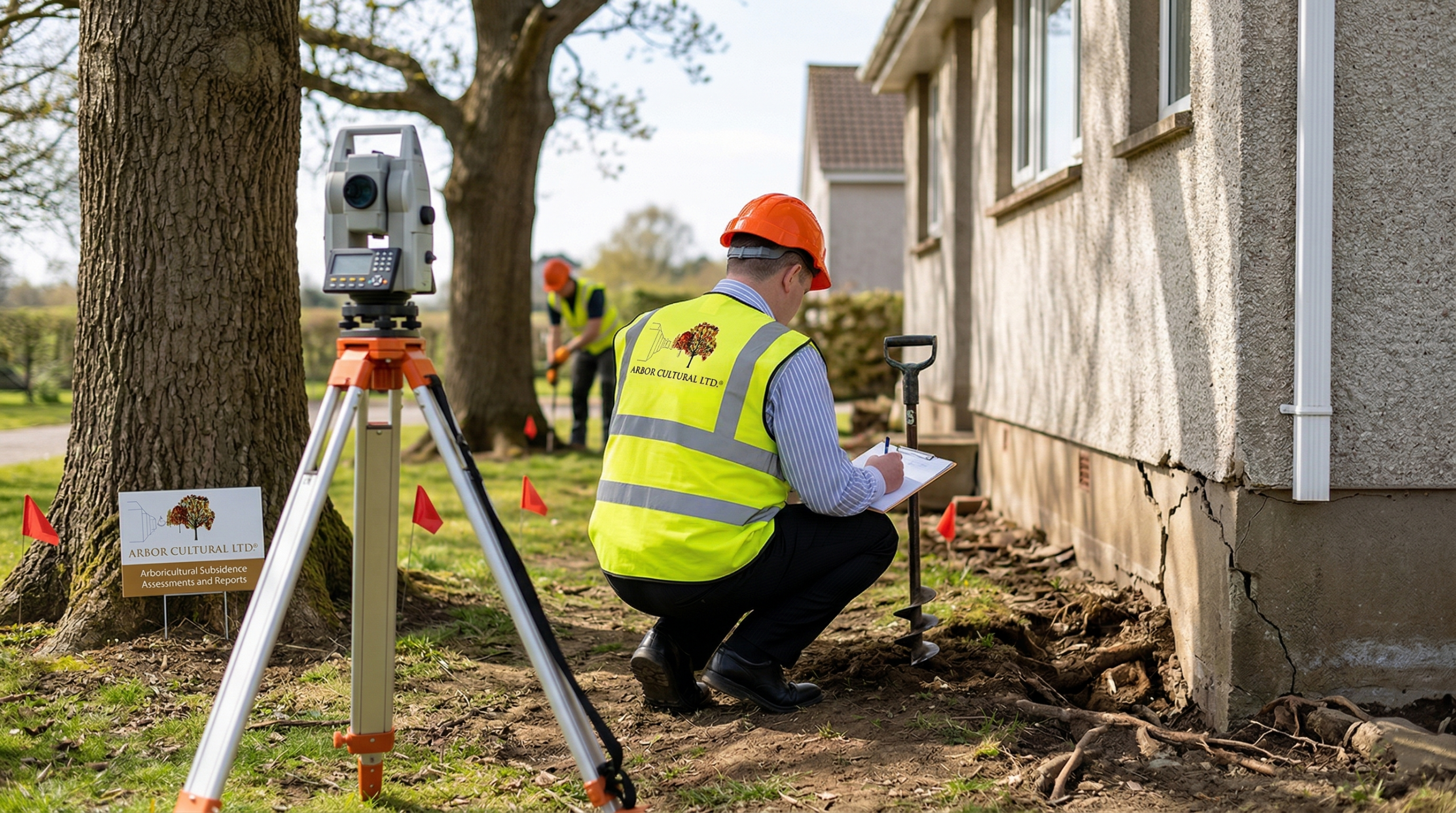
Roots or stems can affect lightweight walls, paving and other structures through direct contact or displacement. That is different from foundation movement caused by soil shrinkage.
Suspected tree-related movement needs more than a nearby tree and a crack. We assess the vegetation in context with the structural, soil, monitoring, drainage and root evidence available.
FREE · NO OBLIGATION
Tell us where the property is. A consultant will review the reported movement, insurer / engineer information and available evidence and email a fixed-fee proposal for the appropriate arboricultural subsidence scope.
Our team will review your project and reply to . If we need more information to prepare your quote, we’ll get in touch.
This is a request for a quote; your instruction is confirmed once the scope and fee are agreed.
Prefer to talk?
0204 531 6444
Or
email your insurer / engineer information
.
A tree subsidence report is the arboricultural part of a suspected building-movement investigation. It assesses whether nearby trees or woody vegetation are plausibly contributing to movement and relates the tree evidence to the available engineer, monitoring, foundation, soil, drainage and root information. A professional report should identify uncertainty as clearly as it identifies evidence.
Strong subsidence reports test the tree hypothesis against the wider evidence. That is the standard property owners, insurers, engineers and planning authorities need when the consequences of the recommendation can be significant.
Cracks can have multiple causes. Structural assessment and monitoring help establish whether meaningful movement is occurring and how it behaves over time.
Tree-related shrinkage is especially associated with shrinkable cohesive soils. Soil plasticity and moisture evidence help test whether that mechanism is plausible.
Foundation depth, foundation type and drainage defects can materially change the interpretation of the claim.
Species, size, vitality, growth potential, water demand, distance and management history are considered together rather than as isolated facts.
Roots in the soil can be useful evidence, but their identity, location and relationship to the affected foundations need to be established and interpreted properly.
The terminology matters because each mechanism needs different evidence and can lead to different management decisions.
Roots or stems can affect lightweight walls, paving and other structures through direct contact or displacement. That is different from foundation movement caused by soil shrinkage.
On shrinkable soils, vegetation can contribute to moisture loss and soil-volume change. The affected foundation may move downward if the ground supporting it shrinks.
Removal of established vegetation can allow some desiccated soils to rehydrate and expand. This is one reason tree removal should be evidence-led rather than automatic.
Buildings and made ground can settle for reasons unrelated to trees. Structural professionals need to distinguish settlement from ongoing ground subsidence.
Drainage defects can also cause or contribute to movement. A good investigation checks plausible alternatives instead of treating trees as the default explanation.
A tree can be one contributing factor among several. The report should describe the strength and limitations of the evidence rather than force a simplistic yes / no conclusion.
Government guidance for protected-tree subsidence cases and many local-authority claim procedures expect far more than a tree survey alone. The exact package depends on the property and claim, but these are the recurring evidence categories.
A clear description of the affected building, where movement is visible, when it was first noted and whether relevant alterations or underpinning have occurred.
An arboricultural opinion should sit alongside the building-side investigation where structural movement is being alleged.
Monitoring helps show whether movement is continuing, seasonal and spatially consistent with the alleged mechanism.
Trial-pit or borehole information can establish foundation type, depth and the soil profile below the affected structure.
Relevant evidence can include soil type, liquid limit, plastic limit, plasticity index, moisture content and other geotechnical interpretation.
Roots found in relevant soil or investigation locations may need botanical identification; where identity is inconclusive, more specialist identification can be required.
Drain defects can cause or contribute to ground movement and should not be ignored simply because trees are nearby.
Tree species, dimensions, vitality, water demand, distance, management history and relationship to the affected building are considered together.
Removal is not automatically the right answer; the project team should consider heave risk and realistic alternatives before recommending major tree work.
One of the biggest weaknesses in generic competitor pages is making the arboriculturist sound as if they replace every other specialist. They do not. The strongest cases join the evidence together while keeping professional roles clear.
| Professional / party | Main role | Typical evidence | What they do not replace |
|---|---|---|---|
| Arboricultural consultant | Assess vegetation, tree characteristics, condition, water-demand context, proximity, management and root / tree evidence. | Tree survey, arboricultural report, vegetation plan, interpretation of relevant root and tree data. | Structural engineering, laboratory soil testing or insurer decisions. |
| Structural engineer / building surveyor | Assess the building, damage, movement, foundation significance and structural remedy. | Damage survey, crack pattern, structural appraisal, foundation interpretation and repair advice. | Detailed arboricultural species / tree-management opinion. |
| Geotechnical / laboratory team | Investigate soil properties and relevant samples. | Soil profile, moisture data, liquid / plastic limits, plasticity index and related testing. | Arboricultural causation opinion or structural design. |
| Monitoring / investigation contractor | Gather repeatable movement and site-investigation data. | Level monitoring, crack monitoring, trial pits, boreholes, drainage surveys and sampling. | Final multi-disciplinary interpretation. |
| Insurer / loss adjuster | Manage the claim, appointments, policy position and claim decisions. | Claim file, appointed expert reports, repair / mitigation decisions. | Independent technical opinions from relevant specialists. |
| Local Planning Authority | Determine protected-tree applications where TPO or Conservation Area controls apply. | Submitted technical evidence and planning / arboricultural assessment. | The insurer's claim decision or structural engineer's repair design. |
No single tree measurement proves causation. The arboricultural assessment combines several lines of evidence and then checks whether the wider investigation supports the same explanation.
Different species have different growth and water-use characteristics. Species is relevant, but it must be interpreted alongside soil, size, distance and evidence of movement.
A tree's present dimensions and likely future development help describe the scale and persistence of vegetation influence.
Physiological condition is relevant to current growth and water use. Where genuinely needed, specialist vitality testing may provide additional context.
Distance is considered together with tree dimensions and the foundation / soil evidence. A close tree is not automatically causal and a more distant tree is not automatically irrelevant.
Removal, pollarding, heavy pruning or changes in the vegetation pattern can alter the site's moisture regime and should be understood where relevant.
Levels, drainage, neighbouring vegetation and the layout of structures can influence how the evidence is interpreted.
More testing is not automatically better. Specialist methods are most useful when they close a real evidence gap in the claim.
Where safely and appropriately scoped, air excavation can expose roots or soil with less mechanical disturbance and help document root presence or site relationships.
View Air Spade investigation →Where it matters which tree a root originated from, the investigation may require botanical identification or specialist laboratory analysis if conventional identification is inconclusive.
Arbor Cultural's existing service range includes chlorophyll-fluorescence vitality testing. In a complex case, vitality data may add context to the tree's physiological condition.
View tree vitality testing →If a proposed management option depends on the structural condition of the tree, additional decay investigation can sometimes help answer that separate tree-safety question.
View decay detection →Where removal or major pruning is proposed because a protected tree is alleged to be damaging property, the Local Planning Authority is entitled to expect evidence rather than assertion.
The case should explain the building damage, movement and why the proposed tree work is relevant to the problem being investigated.
A plan and arboricultural information should identify the relevant trees and their relationship with the affected building.
Protected-tree subsidence cases commonly rely on trial-pit / borehole, foundation and soil information alongside the tree evidence.
Root location and identification can strengthen the evidence, particularly where the identity of implicated vegetation is disputed.
Applications should show that the proposed work is proportionate. Retention, management, engineering and other alternatives may need to be considered.
Where substantial vegetation removal is proposed on shrinkable soil, the wider project team should consider whether soil recovery could create a heave risk.
Upload the insurer, engineer or surveyor wording together with photographs, monitoring, soil or investigation information already available.
We review whether the issue is a standard property / insurance tree report, a tree-related subsidence investigation, TPO evidence or a wider multi-disciplinary claim.
The consultant records the trees and vegetation relevant to the alleged damage, including off-site trees where they can reasonably be assessed.
Available structural, monitoring, soil, foundation, drainage and root-identification information is considered alongside the arboricultural findings.
The report explains whether the vegetation is plausibly relevant, what the evidence supports, what remains uncertain and what proportionate next steps are recommended.
Where needed, the report can support discussion with insurers, engineers, loss adjusters, tree owners or the Local Planning Authority, while final decisions remain with the relevant party.
The right recommendation depends on what the evidence actually supports. The arboricultural response should be proportionate to the contribution of the tree and the wider structural strategy.
| Possible outcome | When it may be considered | Important limitation | Who else may need input |
|---|---|---|---|
| No tree work / continue monitoring | Evidence is incomplete, movement is not clearly linked to vegetation, or the claim is still being investigated. | Monitoring must be meaningful and coordinated with the wider investigation. | Engineer, insurer, monitoring contractor. |
| Pruning / cyclical management | Where proportionate management is supported and realistic for the tree and claim. | Pruning does not automatically provide a permanent reduction in subsidence risk. | Arboriculturist, insurer, tree owner, LPA if protected. |
| Tree removal | Where evidence supports material vegetation influence and removal is justified within the wider remediation strategy. | Heave and protected-tree controls may need consideration. | Engineer, insurer, LPA, tree owner. |
| Root barrier / specialist intervention | Selected sites where a technically viable barrier or root-management strategy is justified. | Depth, continuity, tree stability and engineering effects can make barriers complex. | Engineer, arboriculturist, specialist contractor. |
| Structural remedy | Where building stabilisation or repair is needed irrespective of tree management. | Foundation design and underpinning are structural engineering matters. | Structural engineer, insurer, contractor. |
There is no honest one-price answer because the arboricultural scope can range from a focused tree assessment to review of a substantial technical claim file with TPO evidence, monitoring, root information and several implicated trees. Arbor Cultural reviews the available evidence first and provides a fixed-fee proposal for the agreed arboricultural work.
Number and ownership of trees: one garden tree is different from several neighbouring or public trees.
Evidence already available: a mature claim file with engineer, monitoring, soil and root data requires more technical review than an early-stage enquiry.
TPO / Conservation Area work: protected-tree evidence and application support can add a separate planning component.
Diagnostics: air excavation, vitality work or specialist root identification are only added where they genuinely answer a question.
Meetings / liaison: insurer, engineer, loss-adjuster or LPA coordination should be included explicitly if required.
Upload the insurer / engineer wording, photographs and any monitoring, trial-pit, soil, drainage or root data. We can then quote the correct arboricultural scope rather than a generic package.
Get my fixed-fee quote →The arboricultural inspection can often be arranged promptly, but a credible causation opinion may depend on evidence that takes longer to collect.
We can identify what arboricultural information is available, what is missing and which wider investigations are likely to matter.
Timing depends on location, access, number of trees and current workload.
Engineer reports, monitoring, soil data, root identification and drainage evidence need to be reviewed carefully when supplied.
Some cases need monitoring across a meaningful period before a confident view of the movement pattern can be reached.
Do not wait until every investigation is complete. Send what you already have and we can identify the appropriate arboricultural scope.
Upload the wording that explains the current claim stage and what arboricultural information is being requested.
Structural observations, damage maps, foundation information and the professional hypothesis are useful at scoping stage.
Send crack or level-monitoring data if it already exists, including dates and any interpretation provided by the monitoring professional.
Foundation depth, soil profile, plasticity and moisture information can be central to the wider claim.
Include root-identification, photographs, drainage CCTV or other relevant investigation results where available.
Useful images can help identify the likely survey scope, although they do not replace the site assessment.
| Situation | Likely service | Main question | Link |
|---|---|---|---|
| Lender / insurer wants a preventative property tree report, no reported structural movement | Mortgage & Insurance Tree Report | What tree-related risks should the buyer, lender or insurer understand? | View service → |
| Structural cracking or movement is already suspected | Tree Subsidence Assessment | Are trees plausibly causing or contributing to the movement, and what does the evidence support? | This page |
| Engineer / Building Control needs tree data for new foundations | Building Control Tree Survey | What vegetation information is needed for foundation design? | View service → |
| Roots need controlled exposure / inspection | Air Spade Root Investigation | What roots or soil conditions are physically present in the agreed investigation area? | View service → |
| Protected tree is implicated in a subsidence claim | TPO Advice & Evidence | What technical evidence supports a proportionate application for tree work? | View service → |
Published feedback from clients who have instructed Arbor Cultural for property, insurance, planning and specialist arboricultural work.
These are service areas, not claimed office locations. Open a region to see the named towns and localities covered.
The FAQ content is mirrored in the page's FAQ structured data so the visible page and schema remain aligned.
A tree subsidence report is an arboricultural assessment used where vegetation is suspected of causing or contributing to structural movement. It considers the trees in context with the available building, soil, foundation, monitoring, drainage and root evidence rather than assuming that the nearest tree is responsible.
Tree-related subsidence can occur where vegetation removes moisture from shrinkable cohesive soil, causing the ground to reduce in volume and foundations to move. Trees are only one possible cause of subsidence, so the mechanism should be supported by appropriate evidence.
Yes, in some circumstances. The risk is particularly associated with shrinkable clay soils, moisture-demanding vegetation and foundations that are affected by seasonal soil-volume change. Not every tree close to a building is causing damage.
Potentially. Large shrubs, hedges and groups of woody vegetation can also remove soil moisture. Their relevance depends on species, size, density, soil conditions, distance and the affected structure.
Subsidence is downward movement of the ground supporting a building. Settlement is normally associated with the building or made ground adjusting under load, particularly earlier in a building's life. Distinguishing causes is a structural question and may require an engineer or surveyor.
Heave is upward ground movement associated with soil expansion. On some shrinkable clay sites, removing established vegetation can allow soil to rehydrate and swell, so felling is not automatically a risk-free solution.
Direct damage is physical damage caused by tree growth or contact, such as displacement of paving, walls or lightweight structures. It is different from indirect subsidence damage caused by soil-volume change.
Indirect damage occurs through changes in the supporting ground rather than physical root pressure. In tree-related subsidence cases, the concern is usually moisture extraction from shrinkable soil and resulting foundation movement.
No. Cracking can have many causes. A robust subsidence investigation should consider the crack pattern, movement data, foundations, soil, drainage, vegetation and other plausible causes.
For an insured home with suspected subsidence, contacting the buildings insurer early is usually sensible because the insurer may appoint engineers, surveyors, loss adjusters and investigation contractors. The ABI also advises policyholders to contact their insurer when subsidence is suspected.
The arboricultural consultant assesses the relevant trees and vegetation, interprets their species characteristics, size, vitality, water demand, distance and management history, and relates those findings to the wider technical evidence.
The structural engineer or building professional assesses the building movement, structural significance, foundation condition and repair implications. Arboricultural evidence complements rather than replaces that work.
The required evidence depends on the case, but robust investigations commonly include building damage information, monitoring, foundation details, soil analysis, root identification, drainage evidence, a vegetation plan and an arboricultural report.
Level monitoring can show the extent, direction and timing of movement. Seasonal patterns may be relevant to a vegetation-related hypothesis, while inconsistent movement can point towards other mechanisms.
Crack monitoring helps record whether cracks are stable, opening, closing or changing seasonally. It is one part of the evidence and should be interpreted alongside other investigations.
There is no single period that fits every claim. Some local-authority evidence requirements refer to extended or seasonal monitoring, and insurers or engineers may set the programme according to the specific case.
A trial pit or borehole can provide foundation depth, foundation type, soil profile and locations for sampling or root observations. This helps relate the vegetation to the actual ground supporting the affected structure.
Plasticity describes how fine-grained soils behave as their moisture content changes. Liquid limit, plastic limit and plasticity index can help engineers classify shrinkable clay and its potential for volume change.
Soil moisture deficit describes a reduction in soil moisture relative to an expected state. In a subsidence investigation it can help the wider technical team assess desiccation, but it should not be interpreted in isolation.
Species influences expected mature size, rooting behaviour, water-demand characteristics and response to pruning or removal. Those characteristics help the arboricultural consultant assess plausibility.
A vigorous tree may have different current and future water demand from a declining tree. Vitality is therefore one factor in the overall assessment rather than a stand-alone proof of causation.
Distance helps place the tree in context with its size, species and the affected foundations. A nearby tree may be relevant, but distance alone does not establish causation.
Potentially, depending on species, size, soil conditions, foundation depth and site context. That is why a proper assessment should consider the wider vegetation pattern rather than only the nearest trunk.
Yes. Trees on neighbouring or public land can be relevant if the evidence indicates they may contribute to the damage. Ownership affects permissions and liability, but not the physical assessment.
Yes. Claims involving council trees normally require a structured evidence package and are handled through the authority's insurance or claims process. Requirements vary between councils.
Finding roots near a foundation does not prove which tree they came from. Identification can help link roots to species or individual trees and should be interpreted with the rest of the evidence.
Where root identity is important and conventional identification is inconclusive, more specialist laboratory techniques such as DNA analysis may be considered. The need should be proportionate to the claim.
Where appropriate and safely scoped, air excavation can expose roots or soil around sensitive areas with less mechanical disturbance than conventional digging. It is a diagnostic tool, not automatic proof of subsidence causation.
Drainage defects can contribute to ground movement or foundation problems and should be investigated where relevant. A tree should not be blamed simply because it is close to the property.
The classic vegetation-related shrinkage mechanism is most associated with shrinkable cohesive soils. Other soils can have different movement mechanisms, including erosion or washout, so the wider ground investigation matters.
London Clay is a geological formation containing shrinkable clay that is widespread in parts of London and the South East. Its presence can be relevant to foundation movement, but site-specific soil evidence is still important.
Prolonged dry periods can increase moisture loss from shrinkable soils. The ABI identifies both dry weather and trees or shrubs as potential contributors to subsidence, particularly where clay soils are present.
Pruning can reduce foliage temporarily, but its effect on long-term soil moisture and structural movement depends on species, pruning cycle, tree response and the evidence in the case. It should not be presented as a universal cure.
Removal may be recommended in some evidence-led cases, but it is not automatically appropriate. The investigation should consider whether the tree is materially involved, statutory protection, alternative options and potential heave risk.
Where a long-established tree has dried shrinkable soil, removal can allow rehydration and expansion. The significance depends on the soil, vegetation history, foundations and engineering evidence.
Root barriers can be technically complex and are not suitable for every site. Their feasibility, depth, continuity, engineering effects and impact on tree stability should be evaluated by the appropriate specialists.
Underpinning is a structural remedy and sits outside the arboricultural consultant's decision-making role. An engineer may consider it where other measures are not suitable or where structural stabilisation is required.
Protected status does not make justified work impossible, but applications alleging subsidence should be supported by appropriate technical evidence. Government guidance requires evidence that the tree is a material cause and that other influences have been eliminated so far as possible.
Government and local-authority guidance commonly refers to property damage information, movement monitoring, trial pits or boreholes, soil characteristics, root location and identification, vegetation information and consideration of repair or management options.
Where instructed, Arbor Cultural can provide the arboricultural evidence and tree assessment needed to support the wider application. Structural, soil, monitoring and other evidence may still need to come from the relevant specialists.
Yes. Tree work in a Conservation Area can be subject to statutory notice requirements, and TPO controls may also apply. The correct planning route should be checked before works are carried out.
Arbor Cultural can review relevant soil information as part of the arboricultural interpretation, but specialist geotechnical analysis and laboratory testing remain the responsibility of the appropriate soil or engineering professionals.
Yes, where provided and within the agreed instruction. The arboricultural report can interpret the tree evidence alongside the wider technical material without replacing the engineer's structural conclusions.
Arbor Cultural's existing service information includes Arborcheck vitality testing. Where it is genuinely relevant to a complex case, vitality information may help describe the physiological condition of the tree.
Fees depend on the number of relevant trees, location, complexity of the evidence, whether a TPO application is involved, whether specialist diagnostic work is required and how much technical material must be reviewed. Arbor Cultural provides a fixed-fee proposal for the agreed arboricultural scope.
Timescales depend on site access, the available technical evidence and whether the case is at an early investigation stage or already has monitoring, soil and root data. Some claims cannot be concluded responsibly until sufficient evidence has been gathered.
Send the property address, insurer or loss-adjuster correspondence, structural engineer or surveyor reports, crack or level monitoring, trial-pit or borehole information, soil analysis, drainage reports, root-identification results, photographs and details of relevant trees if available.
No. The report provides an independent arboricultural opinion based on the evidence available. Insurers, engineers, loss adjusters, tree owners and Local Planning Authorities make their own decisions within their respective roles.
Send the property address and whatever evidence already exists. A consultant can review the claim stage, identify the right arboricultural scope and provide a fixed-fee proposal before you instruct.