Technical arboricultural investigation for structural claims. We provide independent Subsidence Assessments and Reports to determine if trees are the causal link in property damage across London and the South East.
Are you looking for an arboricultural consultant to provide a technical report for a subsidence issue? Do you require a tree report for insurance purposes to address structural damage to a property? At Arbor Cultural Ltd, we specialize in Subsidence Assessments and Reports that provide the definitive evidence required by insurers, loss adjusters, and homeowners. We investigate the complex relationship between trees and buildings, using soil analysis, building monitoring data, and root mapping to assess whether trees are the likely cause—or partial cause—of direct or indirect damage. As independent experts based in West Molesey and Crawley, our reports are biased-free and trusted by local planning authorities to resolve high-stakes disputes and help you Finish the Build.
Subsidence typically occurs when a building's foundations move vertically due to changes in the supporting soil. In the South East, particularly across London and Surrey, the presence of high-plasticity clay soil makes properties uniquely vulnerable. Indirect damage is caused when tree roots extract moisture from the clay during the growing season, causing the soil to shrink and the foundations to drop. Conversely, direct damage occurs when the physical growth of roots or stems exerts pressure on structures, such as driveways or boundary walls. Our professional Subsidence Assessments and Reports distinguish between these two phenomena with scientific precision.
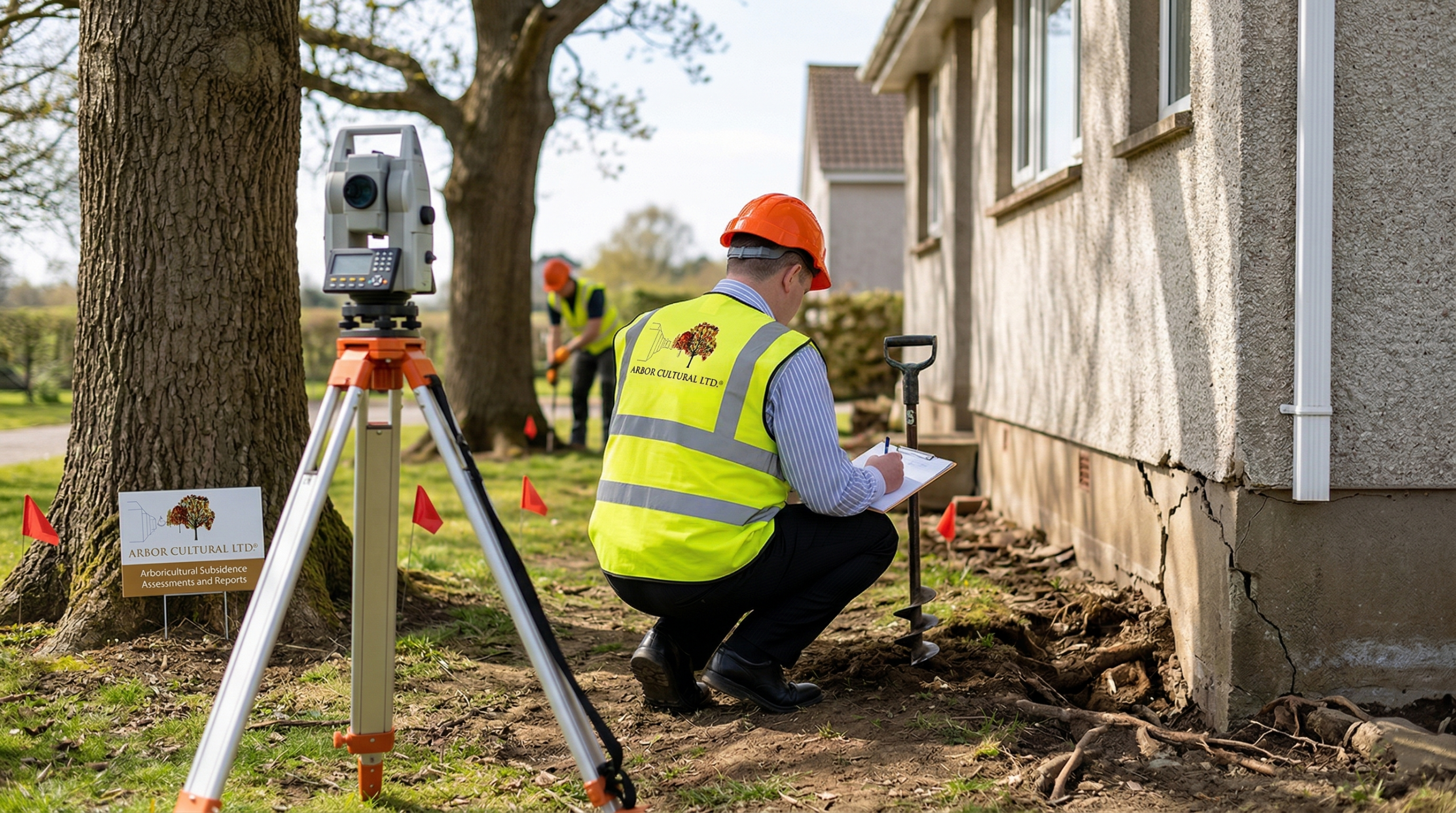
We do not rely on guesswork. Our investigative process integrates multiple data streams to provide an auditable technical conclusion. We cross-reference soil plasticity indices, foundation depths, and crack monitoring data with our own arboricultural findings. This creates a robust risk profile that determines if felling, pruning, or a root barrier is the most appropriate remedial action. All work is carried out in accordance with the principles of NHBC Chapter 4.2 and BS3998 Standards.
To prove root presence, we utilize Air Spade excavation. This allows us to expose the root system near the building's footprint without damaging the tree or the structure, providing visual and physical proof of root activity within the foundation zone.
Clay soils in the South East vary in their "shrink-swell" potential. We assess soil analysis reports to determine the Plasticity Index. High-plasticity clays are significantly more reactive to tree root moisture extraction, often requiring more extensive mitigation strategies to stabilize the structure.
A tree's water demand is directly linked to its vitality. We use the Arborcheck system to measure chlorophyll fluorescence. This data helps determine if a tree is at its peak water-consumption stage or if it is in decline, which impacts the risk of future subsidence.
Many trees involved in subsidence claims are protected by Tree Preservation Orders (TPO). We provide the expert arboricultural evidence required to negotiate with Local Authority Tree Officers, ensuring that any removal or pruning is legally sanctioned and planning conditions are met.
In a subsidence claim, the arboricultural consultant acts as the bridge between the structural engineer and the local planning authority. Structural engineers identify that movement is occurring; we identify if a tree is the biological engine driving that movement. Our Subsidence Assessments and Reports evaluate the species’ specific water demand, the proximity to the foundations, and the potential for recovery if the tree is removed (addressing the risk of "heave"). We ensure that the remedial recommendations are proportional and defensible, preventing unnecessary felling while protecting the building's structural future.
For new builds and developments, compliance with NHBC Chapter 4.2 is essential. This standard dictates foundation depths based on the mature height of nearby trees and the plasticity of the soil. We provide pre-construction Subsidence Assessments and Reports to help developers design foundations correctly from Day One. If you are developing in London or Surrey, our BS5837 surveys work in tandem with our subsidence expertise to ensure your site is safe for the long term.
Arbor Cultural Ltd is a diagnostic-only consultancy. Because we do not carry out tree surgery, we have no financial interest in recommending the removal of a tree. This impartiality is our greatest asset; it means our Subsidence Assessments and Reports carry significant weight in insurance disputes and court proceedings. We are Bond Solon trained and members of the Consulting Arborist Society (CAS), providing expert witness services where required. Trust the technical experts to provide the clarity you need to resolve subsidence issues once and for all.

Contact us via our simple form or by phone. We assess your specific needs and provide a fixed-fee proposal with zero hidden costs.

We arrange a visit at your convenience. Our consultants use advanced decay detection technology to gather precise data efficiently.

We produce a legally defensible report, delivered digitally—ready for immediate submission to your council or lender.