Branches, stems & roots
Physical contact can affect roofs, gutters, walls, fences, paving or other structures depending on the specific relationship.
Has your mortgage lender, insurer or building surveyor asked for an arboricultural report? Send us the wording. We’ll identify the right inspection scope and provide a fixed-fee proposal before you instruct.
FREE · NO OBLIGATION
Tell us where the property is. A consultant will review the lender, insurer or surveyor wording and email a fixed-fee proposal for the appropriate mortgage / property report scope.
Our team will review your project and reply to . If we need more information to prepare your quote, we’ll get in touch.
This is a request for a quote; your instruction is confirmed once the scope and fee are agreed.
Prefer to talk?
0204 531 6444
Or
email your lender wording or survey
.
A mortgage or insurance tree report is a specialist arboricultural assessment requested when a lender, insurer, building surveyor or buyer wants professional evidence about trees near a property. It can address tree condition, direct damage, potential indirect damage such as subsidence on shrinkable soils, statutory tree controls and practical management recommendations.
A lender request does not mean the property is defective. It usually means a valuer or surveyor has identified nearby trees or vegetation and wants a qualified arboricultural opinion before the lending decision is finalised.
The surveyor may want the species, size, condition and relationship with the property assessed professionally.
The report can consider whether there are foreseeable direct or indirect tree-related concerns and what proportionate management is appropriate.
A tree can influence the property even when it grows beyond the legal boundary, so relevant off-site trees may form part of the agreed assessment.
The purpose is evidence: identify the material tree issues, distinguish manageable concerns from significant ones, and set out clear next steps.

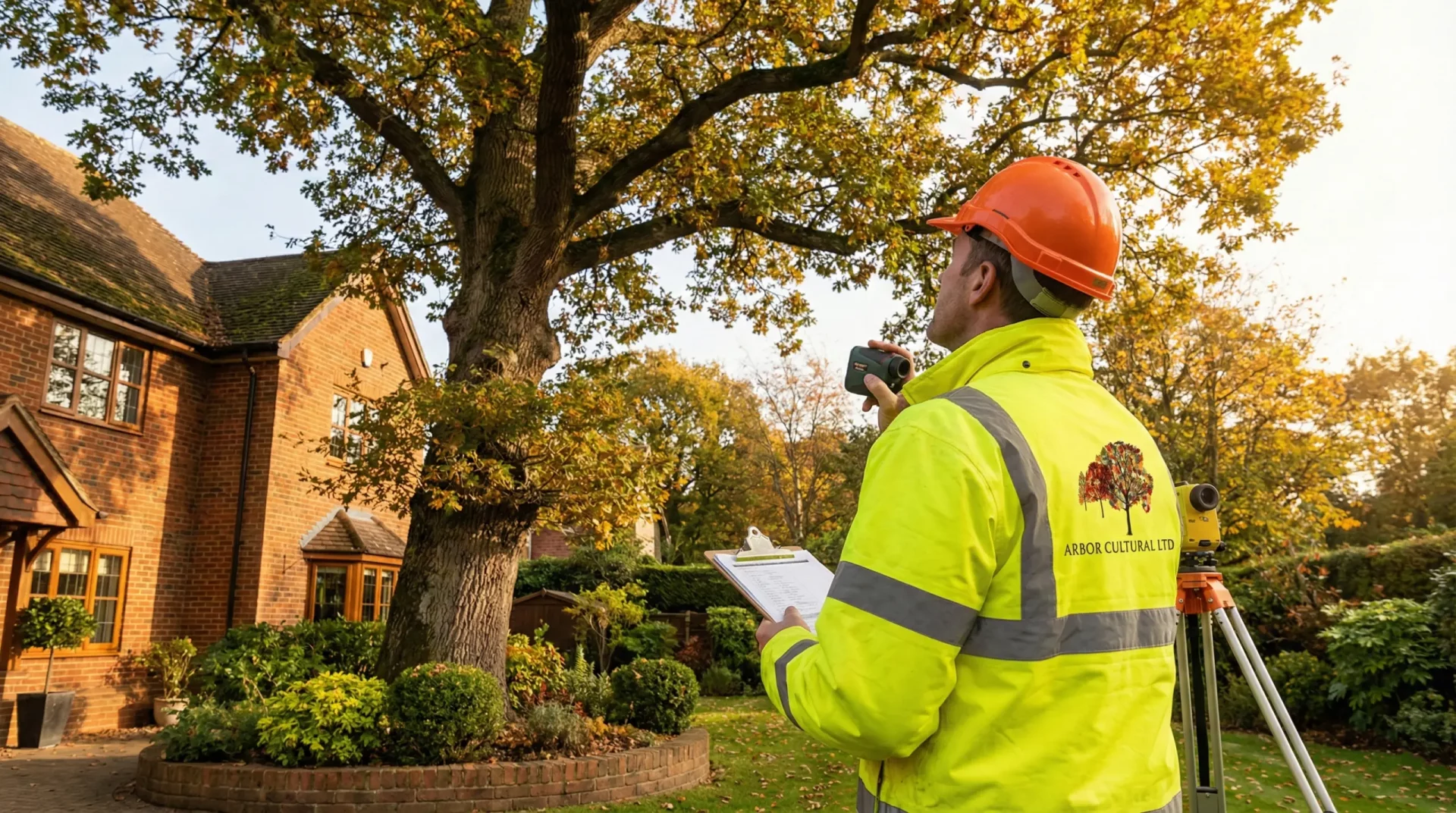
The best report is not the longest possible template. It is the report that answers the actual lender / surveyor question, records the relevant tree evidence and makes recommendations that are proportionate to the property.
The report records why the assessment has been commissioned and the specific concern raised by the lender, insurer, surveyor or buyer.
The assessment explains the relevant relationship between the property, trees, boundaries, topography and other visible site factors.
The survey considers vegetation within the agreed influencing scope, including off-site trees where relevant and reasonably observable.
Core tree information is recorded so present condition and future relationship with the property can be understood.
Visible relationships with structures, hard surfaces, roofs, walls and other property features can be considered.
Where relevant, the report considers vegetation, shrinkable soil context, water demand and the limitations of a pre-purchase assessment.
Significant defects or condition issues can be recorded with proportionate management recommendations.
Tree Preservation Orders and Conservation Area issues can be highlighted where they affect recommended management.
The report sets out proportionate next steps, which may include retention, pruning, monitoring, further investigation or removal where justified.
Competent mortgage reporting separates the mechanisms instead of using “tree risk” as a catch-all phrase.
Physical contact can affect roofs, gutters, walls, fences, paving or other structures depending on the specific relationship.
On cohesive soils, vegetation water demand can be relevant to soil moisture and foundation movement. A mortgage report assesses potential risk; existing structural damage needs a different investigation.
Material defects, instability, deadwood or foreseeable branch / tree failure can be relevant where they could affect people or property.
Roots and growth can contribute to local displacement or distortion of hard surfaces, although the importance depends on construction and site context.
Roots can exploit defects in drains, but drainage condition is not diagnosed by a visual tree survey. Specialist drainage investigation may be appropriate where this is a real concern.
The assessment can consider species, vitality, growth potential, distance, water-demand characteristics and the practical long-term relationship with the home.
This distinction is one of the most important parts of the service page because it prevents a buyer from commissioning the wrong report.
The lender, insurer or surveyor wants an arboricultural assessment of nearby trees, potential property risk, tree condition and appropriate management before the transaction or policy proceeds.
Request a mortgage / insurance tree report →If structural damage is already present, the question changes. A dedicated subsidence / heave assessment may need to coordinate vegetation evidence with structural, geotechnical and other investigation.
View subsidence assessments →On shrinkable clay, tree-related property risk is not solved by automatically removing vegetation. The recommendation should reflect the tree, soil, property and evidence.
Vegetation can contribute to moisture loss from shrinkable soil, which may be relevant to downward foundation movement in the right circumstances.
Removing established vegetation can allow some shrinkable soils to rehydrate and expand. Where that risk is material, removal needs to be considered carefully.
Species characteristics, tree size, vitality and growth potential can affect the vegetation / soil relationship.
Tree position, property distance, levels and local site form can all help explain whether a concern deserves further attention.
High-street lenders, building societies and specialist lenders can all receive valuation or surveyor advice that leads to an arboricultural report request. The safest approach is to scope the report from the actual wording rather than promise that one generic template fits every bank.
These names are examples only. This page does not claim a direct commercial relationship between Arbor Cultural and any named lender. Lender acceptance is ultimately a decision for the lender / valuer / underwriter.
| Question | Why the buyer cares | Why the lender / insurer cares | What the report can contribute |
|---|---|---|---|
| Are the trees in reasonable condition? | Future safety and maintenance costs matter after completion. | Serious defects can create property and liability exposure. | Condition observations and proportionate management recommendations. |
| Could trees contribute to structural risk? | The buyer wants to understand foreseeable property issues. | The lender wants uncertainty around its security reduced. | Potential direct / indirect risk considerations and clear limitations. |
| Are neighbouring trees relevant? | Management may not be entirely within the buyer's control. | Ownership does not remove possible influence on the mortgaged property. | Reasonable assessment of relevant off-site vegetation where observable. |
| Are trees protected? | Future work may need consent or notice. | Recommended risk mitigation must be practically achievable. | TPO / Conservation Area considerations where relevant to the scope. |
| What should happen next? | The buyer needs a manageable plan rather than vague concern. | The requesting party needs a clear professional conclusion. | Prioritised recommendations, monitoring or further investigation where justified. |
That matters on a mortgage report. The consultant's commercial outcome does not improve if the report recommends pruning or removal. The objective is to explain the evidence and the proportionate response for the property.
“I had a report compiled for remortgage reasons. Arbor Cultural Ltd were extremely friendly, efficient and prompt.”Published Arbor Cultural client feedback · Wayne F
Forward the exact request, property address and any relevant building survey or insurer correspondence.
Arbor Cultural identifies whether the correct route is a mortgage / insurance report, a separate subsidence assessment or another arboricultural service.
The agreed inspection and reporting scope is confirmed before instruction.
A consultant inspects the relevant trees and their relationship with the property within the agreed scope.
Findings, limitations and proportionate recommendations are set out clearly for the buyer, lender, insurer or surveyor.
The client can provide the report to the requesting party; reasonable arboricultural clarification can be handled within the agreed scope.
Competitors commonly publish broad starting prices or ranges, but the right fee depends on the actual property and instruction. Arbor Cultural reviews the request and provides a fixed-fee proposal for the agreed scope.
Number of relevant trees: a single tree beside a house is different from a large plot with many on- and off-site trees.
Neighbouring vegetation: access and visibility can affect what can be assessed reliably.
Lender / surveyor wording: some instructions ask a narrow question; others require broader property-tree assessment.
Structural concerns: existing cracking or movement can change the correct professional route entirely.
Transaction deadline: tell us your real exchange, completion or lender date so availability can be checked before instruction.
Upload the surveyor / lender wording and give us the property postcode. A consultant can confirm the right scope before you spend money on the wrong type of report.
Get my fixed-fee quote →You do not need to write a technical brief. Send what you already have.
Paste the exact request or upload the relevant page of the valuation / building survey.
Enough information to identify the site, likely access and travel requirement.
Property and tree photographs can help with initial scoping, although they do not replace the site inspection where one is required.
This is essential because known structural damage may mean the correct service is a separate subsidence / heave investigation.
Property transactions move quickly. Give us the actual date so the team can tell you what is realistic.
| Situation | Likely route | Why it differs | Service |
|---|---|---|---|
| Lender asks for a tree report during purchase | Mortgage Tree Report | Pre-purchase due diligence focused on the tree / property relationship. | This page |
| Insurer asks for tree information, no existing movement | Insurance / Property Tree Report | Similar property-risk assessment but scoped to the insurer's wording. | This page |
| Cracks, movement or an existing subsidence concern | Subsidence / Heave Assessment | Existing damage requires a different evidential question and may involve structural / geotechnical evidence. | View service → |
| Engineer / Building Control needs trees for foundation design | Building Control Tree Survey | Focuses on vegetation data for foundation design rather than mortgage due diligence. | View service → |
| Primary concern is condition or safety | Tree Health & Safety Report | Focuses on tree condition, risk management and duty of care. | View service → |
Published feedback from clients who have instructed Arbor Cultural for mortgage, property, planning and specialist arboricultural work.
These are service areas, not claimed office locations. Open a region to see the named towns and localities covered.
These FAQs are also reflected in the page's FAQ structured data so the visible content and schema stay aligned.
A mortgage tree report is a specialist arboricultural report prepared when a lender, building surveyor, insurer or buyer needs professional information about trees close to a property. It can assess tree condition, direct-damage risks, potential indirect damage such as subsidence on shrinkable soils, management needs and other property-related tree concerns.
A lender may request an arboricultural report after a valuation or building survey highlights trees close to the property or another tree-related concern. The purpose is to replace uncertainty with professional evidence about the trees and any proportionate management recommendations.
The terms are often used interchangeably. You may also see homebuyer tree report, arboricultural mortgage report, arboricultural survey for mortgage purposes or tree report for house purchase.
No. A mortgage tree report is prepared by an arboricultural consultant and addresses the trees and vegetation. A structural or building survey addresses the building. Where cracking or movement is already present, other professionals and a separate subsidence investigation may be required.
Usually yes. Arbor Cultural's existing service distinction is that standard mortgage / insurance reports are for properties without reported structural damage. Where cracking, movement or suspected subsidence is already present, a dedicated subsidence or heave assessment is the more appropriate route.
A mortgage tree report is generally a pre-purchase or lender / insurer assessment of tree-related risk where structural damage has not already been established. A subsidence report investigates a different problem: existing or suspected movement and the possible contribution of vegetation.
The scope is tailored to the lender or surveyor request, but it can include relevant tree and shrub identification, dimensions, condition, vitality, proximity to structures, growth potential, potential direct damage, tree-related subsidence considerations, statutory protection checks and practical management recommendations.
It can. Trees on adjoining land may be relevant where their size, species, condition or distance means they could influence the property. Ownership does not automatically remove a tree from the professional assessment.
Where relevant to the property risk, large shrubs, hedges and other woody vegetation can be considered alongside trees. The exact scope should follow the lender, insurer or surveyor wording.
Yes, where condition and foreseeable failure risk form part of the agreed mortgage or property scope. Significant defects, deadwood, instability or other safety concerns can be recorded with appropriate recommendations.
A standard mortgage report can consider potential tree-related subsidence risk, especially where shrinkable clay and moisture-demanding vegetation may be relevant. It is not the same as diagnosing an existing subsidence claim where damage has already occurred.
Indirect damage usually refers to ground movement rather than physical root contact. On shrinkable soils, vegetation water demand can contribute to soil moisture changes that may be relevant to foundation movement.
Direct damage can include physical contact or displacement affecting structures, walls, paving, roofs, gutters or other features. The significance depends on the specific tree, property and site relationship.
Roots can exploit defects in drains and other underground infrastructure, but a tree survey does not automatically diagnose the condition of drainage. Where drains are a material concern, specialist drainage investigation may be needed.
They can contribute to local displacement or distortion of hard surfaces where roots and construction details interact. The report can record visible relationships and practical management considerations.
On shrinkable cohesive soils, vegetation can contribute to moisture loss and soil shrinkage. Whether a tree is materially relevant to structural movement depends on the soil, tree characteristics, distance, foundations and other evidence.
Heave is upward ground movement associated with soil swelling. On some shrinkable clay sites, removing a significant moisture-demanding tree can allow the soil to rehydrate and expand, which is why removal is not automatically the safest recommendation.
If a large tree has influenced shrinkable soil for a long period, sudden removal can change the moisture regime. A professional recommendation should therefore consider the property, soil and tree relationship rather than assume removal is risk-free.
Different species have different typical water-demand characteristics. In property and foundation contexts, water demand can be one of the factors considered alongside size, growth potential, soil and distance to structures.
Yes. Species helps inform expected mature size, growth characteristics, water demand, structural behaviour and appropriate future management.
Yes. Vitality and growth potential can affect how a tree is likely to develop and therefore how its future relationship with the property should be understood.
It can. Arbor Cultural's existing mortgage-report material identifies land topography as one of the factors considered alongside species, vitality, growth potential, water demand and distance to buildings.
Where proportionate tree management would reduce an identified risk or improve the long-term tree / property relationship, the report can make management recommendations. Recommendations should be evidence-led rather than based on a presumption that every nearby tree needs work.
Only where justified by the findings. Arbor Cultural operates as an independent consultancy and does not sell tree surgery, so the report can consider retention, pruning, monitoring or removal without a financial incentive to generate tree-work income.
Potentially. Trees protected by a Tree Preservation Order or located in a Conservation Area can be subject to statutory controls. Any recommended work should be checked against the applicable local authority requirements before it is undertaken.
The scope can include relevant statutory tree-protection considerations. If a lender or buyer needs a formal planning-status check, the report should state the source and limitations of the information used.
A neighbouring tree can still be relevant to the property's risk assessment. The report can assess what is reasonably observable, but recommendations involving someone else's tree need to respect ownership, access and legal constraints.
Yes, where the insurer is asking for a property tree assessment rather than investigation of an existing structural-damage claim. Send the insurer's exact wording so the scope can be checked.
They can overlap substantially where the request is a preventative assessment of nearby trees, but the insurer may ask different questions. The safest approach is to scope the report from the actual insurer wording.
Yes, where a lender or surveyor requests arboricultural information during a remortgage. Arbor Cultural's own published client feedback includes a client who commissioned a report for remortgage purposes.
Yes. A buyer can commission a pre-purchase tree report even without a lender where they want professional due diligence on trees near the property.
No. A report is usually requested when the lender's valuer, building surveyor or other professional raises a tree-related concern. Many purchases proceed without a specialist arboricultural report.
No. A request often means the lender or surveyor wants uncertainty investigated. The professional assessment may identify low, manageable or more significant concerns depending on the property.
If your lender is Barclays, HSBC, Nationwide, Santander, Lloyds or another bank, building society or specialist lender, send the exact valuation or surveyor wording. The scope should be prepared around the actual request rather than assuming every lender uses the same template.
This page does not claim a direct commercial relationship with those lenders. They are named as examples of major UK lenders whose borrowers may receive arboricultural information requests. Send the wording you have received and Arbor Cultural can scope the report accordingly.
The Consulting Arborist Society directory lists Arbor Cultural with Mortgage Reports as a verified competency. Arbor Cultural's existing website also states that it has completed the CAS Tree Report for Mortgage qualification and is Lantra accredited.
Arbor Cultural's current published consultant information states professional indemnity cover of £2 million including mortgage and insurance reports, together with £10 million public liability cover. Insurance details should be reconfirmed if a lender requires a current certificate.
Turnaround depends on access, location, survey complexity and current workload. Mortgage transactions are often time-sensitive, so include your genuine exchange, completion or lender deadline with the enquiry and the team can confirm what is realistic before instruction.
Fees depend on the property location, number and complexity of relevant trees, access, neighbouring vegetation, lender wording and required output. Arbor Cultural reviews the scope first and provides a fixed-fee proposal rather than using a generic one-price template.
Yes. Arbor Cultural's premium enquiry process is designed to confirm the professional scope and then provide a fixed-fee proposal before instruction.
Send the property postcode or address, lender / insurer / surveyor wording, the building survey if available, useful property or tree photographs, any known structural concerns and your real transaction deadline.
Yes, if it contains the tree-related request or relevant observations. The exact wording can help avoid producing the wrong type of arboricultural report.
The arboricultural survey is primarily concerned with trees, vegetation and their relationship with the property. If internal cracking or structural movement is already an issue, that may indicate a different investigation requiring other professionals.
Sometimes relevant features can be assessed from lawful available viewpoints, but limitations must be stated. If access is essential to a reliable conclusion, that should be identified before the report is finalised.
No. The report provides professional arboricultural evidence. The lender, valuer, insurer or underwriter decides whether its requirements have been satisfied and whether the mortgage or policy proceeds.
Yes. A pre-purchase report can identify foreseeable tree-management issues, statutory constraints and property relationships that a buyer may wish to understand before exchange.
Send the wording, property postcode and your real transaction deadline. A consultant can confirm the right report scope and provide a fixed-fee proposal before you instruct.