Brief the site team
Review the relevant AMS / TPP requirements with the contractor so tree-related controls are understood before the sensitive operation starts.
Need supervision for a planning condition or sensitive construction near retained trees? Send the condition, AMS and Tree Protection Plan and we’ll identify the site visits, checks and reporting your project actually needs.
FREE · NO OBLIGATION
Tell us where the site is. A consultant will review the planning condition, AMS, Tree Protection Plan and construction stage and email a fixed-fee proposal for the appropriate supervision scope.
Our team will review your project and reply to . If we need more information to prepare your quote, we’ll get in touch.
This is a request for a quote; your instruction is confirmed once the scope and fee are agreed.
Prefer to talk?
0204 531 6444
Or
email your condition and approved documents
.
Arboricultural supervision is the construction-stage part of the BS5837 process: an arboriculturist attends agreed stages of a development to inspect tree-protection measures, observe sensitive work near retained trees and create the monitoring records required by the project scope. It is also commonly described as arboricultural site monitoring or an Arboricultural Clerk of Works role.
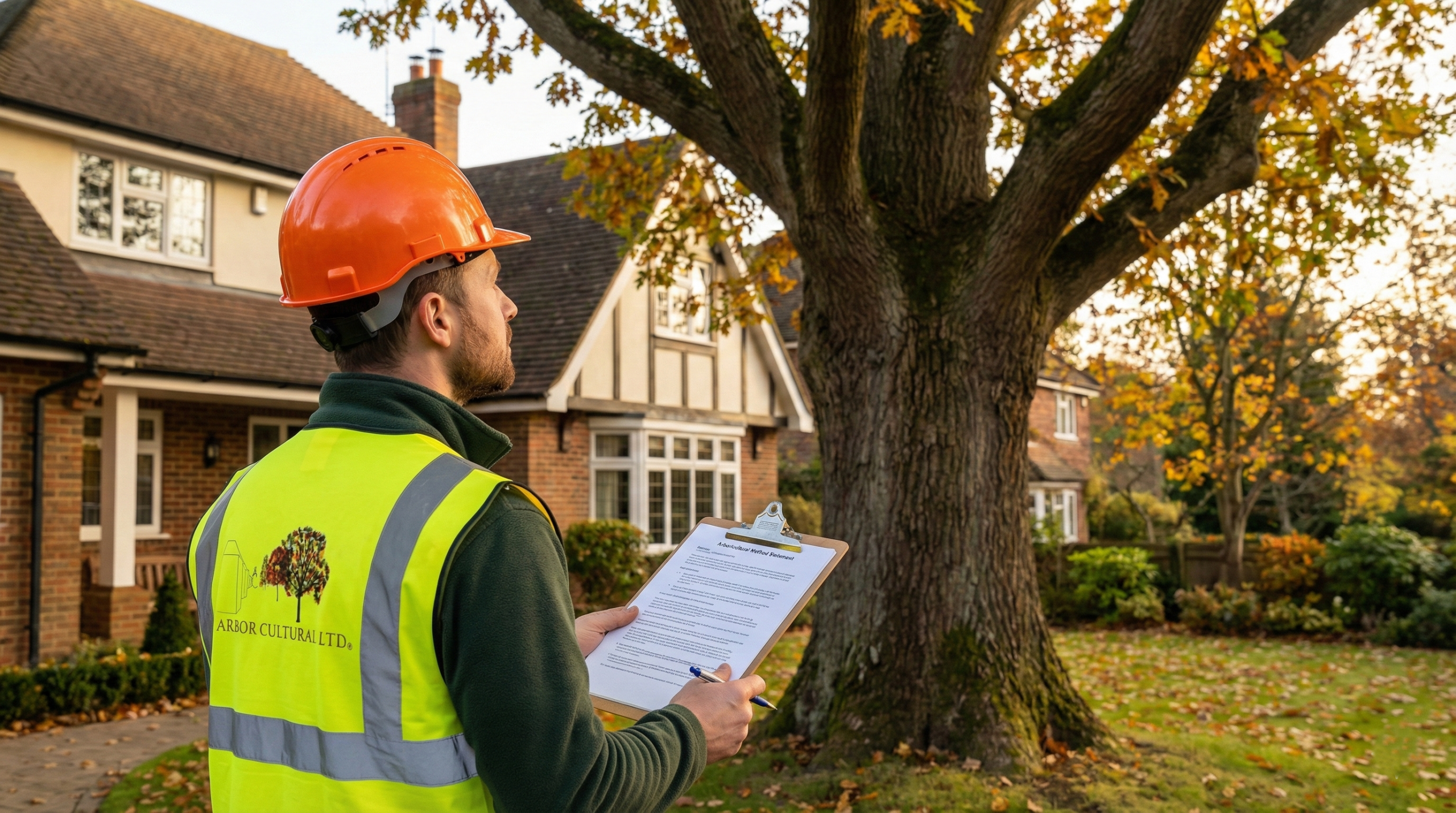
Supervision is normally tied to a real construction-stage risk or a planning requirement. The correct approach is to identify the critical operations that need arboricultural attendance rather than adding unnecessary site visits.
A decision notice may require an arboricultural watching brief, scheme of site monitoring, compliance checks or evidence before / during development.
The approved AMS may identify operations that need direct attendance, inspection or sign-off by the project arboriculturist.
Controlled excavation, piles, services, no-dig surfacing or other sensitive work can require arboricultural attendance where specified by the approved method.
Fencing, exclusion zones and temporary ground protection may need to be inspected before demolition, clearance, deliveries or construction begin.
Longer or more complex projects can use periodic site inspections to check that protection remains effective and that the approved strategy is still being followed.
The role is not to run the construction site. It is to provide arboricultural oversight at the agreed stages, explain the tree-protection requirements, observe sensitive works and create a clear record of what was found and what action is needed.
Review the relevant AMS / TPP requirements with the contractor so tree-related controls are understood before the sensitive operation starts.
Check the position and condition of agreed barriers, construction exclusion areas, signage and temporary ground protection.
Observe agreed excavation, pile-related work, hand digging, service installation or specialist construction where arboricultural attendance is specified.
Create photographs and written notes that show what was inspected, what was observed and whether follow-up action is needed.
If the live site no longer matches the approved drawings or protection strategy, flag the issue before it develops into a larger tree or planning problem.
Provide the agreed monitoring information that the client or project team can use where the planning condition requires construction-stage arboricultural evidence.
Not every project needs every stage. The actual monitoring schedule should follow the planning condition, approved AMS, Tree Protection Plan and construction programme.
Brief the project team on the approved arboricultural documents, tree-protection rules and sensitive operations.
Inspect agreed fencing, exclusion zones, signage and ground protection before damaging site operations begin.
Attend where demolition or enabling work close to retained trees is identified for arboricultural supervision.
Monitor agreed hand excavation, pile-related work or other sensitive operations where the approved method requires attendance.
Attend controlled operations where underground services, drainage or no-dig construction interact with tree constraints.
Inspect protection measures and relevant site activity at agreed intervals and record actions where required.
Record the relevant completion stage and provide the agreed evidence for the client or planning-condition process.
One of the most useful monitoring visits is often the one that happens before the damaging operations begin. It is easier to move a fence or correct a protection detail before plant, deliveries and excavation reach the area.
| Item | What can be checked | Why it matters | Typical evidence |
|---|---|---|---|
| Protective fencing | Position, continuity, condition and relationship to the approved TPP. | A misplaced or incomplete barrier can expose the protected area to routine construction traffic. | Visit note, photographs and corrective actions where required. |
| Ground protection | Extent, condition and whether the agreed system is in place before traffic uses the area. | Sensitive rooting areas can be affected by repeated loading and soil compaction. | Photographs, observations and follow-up checks. |
| Construction exclusion areas | Whether the protected zone is understandable to the site team and kept free from normal construction use. | Storage, skips, parking and contractor shortcuts can undermine an otherwise correct TPP. | Site record and agreed actions. |
| Site compounds / storage | Whether welfare, spoil, materials and parking are positioned consistently with the tree-protection strategy. | The site has to function without turning retained-tree areas into overflow working space. | Photographs and project-team communication. |
| Toolbox talk / briefing | Whether relevant contractors understand the tree-protection rules and escalation process. | Good drawings only work if the people carrying out the construction know what the symbols and restrictions mean. | Attendance / briefing record where included in scope. |
The purpose of attendance is not to make an unapproved operation acceptable. The proposed work should first be addressed by the planning / design documents. Supervision then helps the contractor implement the agreed method at the live construction stage.
Where hand digging is specified, attendance can help identify significant roots and keep the operation aligned with the approved method.
Some projects require attendance before or during pile-related excavation or other foundation stages close to retained-tree rooting areas.
Cellular confinement or other no-dig systems can still be sensitive to preparation, edge detailing and construction traffic, so specified inspection stages can be useful.
Controlled installation may need attendance where roots are encountered or the approved route passes through a sensitive area.
Where an existing surface has protected the underlying soil, its removal can be a sensitive stage that benefits from a defined method and monitoring.
If roots, levels or construction conflicts differ from the information used at design stage, the arboriculturist can record the issue and help route it through the correct project decision process.
The value of supervision is not only the site attendance. A clear record gives the client, contractor and planning team evidence of what was inspected, what was observed and what needs to happen next.
It should distinguish observations from actions, identify the project stage and avoid claiming that a planning condition has been discharged unless the Local Planning Authority has actually confirmed that outcome.
Date & project stage: when the visit happened and which construction operation was being checked.
Documents reviewed: relevant AMS, TPP, planning condition or drawing revision.
Photographs: visual record of protection measures, sensitive operations or identified issues.
Observations: what was present on site and whether it matched the agreed arboricultural information.
Actions: any corrective measure, follow-up, further attendance or project-team decision required.
Distribution: who needs the record — client, contractor, project manager or Local Planning Authority where required.
The construction-stage arboriculturist should be working from the approved project information. Survey, AIA, TPP, AMS and supervision each answer a different question.
| Document / service | Main question | Typical stage | Relationship to supervision |
|---|---|---|---|
| BS5837 Tree SurveySurvey service → | What trees are present and what is their quality, size and condition? | Early design / planning | Provides the baseline tree information. |
| Arboricultural Impact AssessmentAIA service → | How does the proposed design affect the trees? | Planning assessment | Explains the impacts and mitigation strategy that later documents implement. |
| Tree Protection PlanTPP service → | Where do protection measures and construction constraints apply? | Condition / pre-construction | Gives the spatial plan against which protection can be inspected. |
| Arboricultural Method StatementAMS service → | How will sensitive construction operations be carried out? | Condition discharge / construction | Defines the methods and often the stages that require supervision. |
| Arboricultural SupervisionThis page | Are the agreed tree-protection methods being implemented at the relevant site stages? | Live construction | Provides attendance, monitoring and records during implementation. |
A house extension may only need a pre-start protection check plus attendance during one sensitive excavation or foundation stage identified in the AMS.
A multi-unit or constrained site may need a toolbox talk, fencing sign-off, periodic checks and attendance during selected RPA operations.
Longer programmes can require repeated visits across demolition, enabling, infrastructure and build phases, with clear records tied to the construction sequence.
Construction changes. The important point is to identify tree-related departures before the project team assumes that an approved method can simply be altered on site.
Photograph and describe what has changed — for example a fence line, service route, excavation detail or proposed working area.
Determine whether the change affects a retained tree, RPA, protection measure or supervised operation.
The arboricultural response may need input from the architect, engineer, contractor or drainage / utilities designer.
Material departures from an approved condition, TPP or AMS may require discussion or formal agreement with the Local Planning Authority.
There is no reliable one-price-fits-all fee because supervision is driven by the number of visits, project location, required reporting and the construction operations that need attendance. Arbor Cultural reviews the planning condition and programme first and provides a fixed-fee proposal for the agreed scope.
Number of visits: one protection check is different from a multi-stage monitoring programme.
Critical operations: attendance during excavation, piling, services or specialist surfacing can require specific timing.
Travel / location: site location and realistic attendance windows affect the professional scope.
Reporting: the required level of photographs, visit notes, formal records or planning submissions should be agreed.
Programme changes: cancelled, delayed or short-notice site operations can affect attendance requirements.
Send the planning condition, AMS / TPP and the dates of the operations you think require attendance. If the supervision schedule is unclear, we can review the documents first.
Get my fixed-fee quote →The quickest way to scope site monitoring is to send the documents that already define the approved tree-protection strategy.
Send the exact condition rather than summarising it so the required trigger and evidence can be identified.
The AMS often states which operations need attendance and what the arboriculturist is expected to monitor.
Useful for checking protection locations, exclusion zones, access and areas requiring special methods.
Send the current site / foundation / drainage information where it affects the operation being supervised.
Give the genuine proposed date and time window for the sensitive operation so availability can be considered before instruction.
Published feedback from clients who have instructed Arbor Cultural for planning, development, tree surveys and specialist arboricultural advice.
These are service areas, not claimed office locations. Open a region to see the named towns and localities covered.
If your planning condition or AMS uses different terminology, send the exact wording and Arbor Cultural can review the required construction-stage support.
Arboricultural supervision is construction-stage arboricultural oversight for works that could affect retained trees. The arboriculturist attends agreed stages, checks tree-protection measures or sensitive operations and records observations and actions against the approved project documents.
Site monitoring is the planned inspection and recording of tree-protection compliance during a project. It can include periodic inspections, specific supervised operations and written site-monitoring records.
An Arboricultural Clerk of Works is an arboricultural professional appointed to provide construction-stage oversight, advice and reporting on tree-related matters. The abbreviation ACoW is commonly used; ArbCoW is also encountered in arboricultural project documents.
Supervision may be required by a planning condition, an approved Arboricultural Method Statement, a Tree Protection Plan or the project arboriculturist where sensitive work is proposed near retained trees. The exact requirement depends on the approved documents and site.
Yes. Some planning decisions require an arboricultural watching brief or written scheme of site monitoring to be secured before development, site clearance or other preparatory work begins.
Supervision records can provide evidence for a condition-discharge submission where the condition requires monitoring, sign-off or construction-stage arboricultural records. The Local Planning Authority decides whether a condition is discharged.
No. The Arboricultural Method Statement explains how sensitive works are intended to be carried out. Supervision is the construction-stage attendance and monitoring used to check or support implementation of the approved method.
No. A Tree Protection Plan is mainly a drawing showing where tree-protection measures and construction constraints apply. Supervision checks agreed protection measures or sensitive work on the live site.
No. The need should be proportionate to the project, planning condition and level of arboricultural risk. Some projects need only a pre-start check; others require several monitored stages or attendance during specific operations.
A pre-commencement meeting can be used to review the approved AMS and TPP with the site team, confirm protection measures, identify sensitive operations, agree communication routes and make sure the relevant contractor understands the tree-related constraints.
A toolbox talk is a practical briefing for the contractor or site team explaining the tree-protection rules relevant to the works, including exclusion areas, fencing, ground protection, sensitive operations and what to do if unexpected roots or conflicts are encountered.
Where the planning condition or project documents require it, an arboriculturist can inspect the position and condition of protective barriers and record whether they match the approved Tree Protection Plan or identify corrective actions.
Yes. Where ground protection is part of the approved tree-protection strategy, the arboriculturist can inspect its location and condition and record any required action before or during construction.
Yes, where the works have been approved and the project methodology requires supervision. The arboriculturist can attend agreed excavation stages, observe roots and site conditions and record any actions within the limits of the approved method.
It can. Piling, pile caps, beams and associated excavation can be sensitive where they interact with retained-tree rooting areas, so the approved AMS or planning condition may require attendance at key stages.
Yes. Where hand excavation is specified close to retained roots, arboricultural attendance may be required to observe the operation, identify significant roots and help the contractor follow the approved method.
It can. No-dig surfacing or cellular confinement systems may still require careful preparation, installation and edge detailing, so the approved method may identify stages for arboricultural inspection.
Yes, if the approved route or method passes close to retained trees and the planning documents require arboricultural attendance. Trenchless or controlled excavation methods may also be relevant depending on the project.
It can. Site monitoring may check whether materials, vehicles, welfare units, spoil and compounds remain outside protected areas where that is part of the approved tree-protection strategy.
It can include checking agreed tree work stages where the project scope requires it, but tree work itself should be undertaken by appropriately competent contractors and any separate statutory permissions still apply.
There is no universal frequency. Visits should be tied to the planning condition, AMS, construction programme and risk points. A schedule may include pre-start checks, specific supervised operations, periodic monitoring and a completion visit.
Usually not. Many projects use targeted attendance at critical stages plus periodic monitoring. More intensive supervision may be appropriate where complex works occur close to retained trees.
A monitoring record can include the visit date, project stage, photographs, condition of protection measures, observations, departures from approved documents, actions required and any follow-up or further attendance needed.
Where written monitoring records form part of the agreed scope, Arbor Cultural can document site visits so the client and project team have an auditable record. The exact reporting format and recipients are agreed for the project.
Yes, where required by the planning condition or agreed project procedure. The client or consultant team should follow the submission route required by the Local Planning Authority.
The situation should be reviewed promptly. The arboriculturist can inspect the change, compare it with the approved TPP and advise on corrective action. Material departures may need agreement from the Local Planning Authority.
Work in the affected area should follow the approved method and escalation procedure. The arboriculturist can inspect significant unexpected roots and advise within the scope of the approved arboricultural and engineering information.
Where liaison forms part of the instruction, Arbor Cultural can communicate arboricultural information with the relevant planning or tree officer. Formal planning decisions remain with the Local Planning Authority.
Sometimes, but early involvement is preferable. If work has already started, the available approved documents, condition wording and current site situation need to be reviewed before an appropriate monitoring scope can be agreed.
Cost depends on the number and timing of required visits, travel, site complexity, reporting requirements and whether attendance is needed during specific construction operations. Arbor Cultural reviews the condition and programme first and provides a fixed-fee proposal for the agreed scope.
Availability depends on the location, required attendance date, complexity of the works and current workload. Send the genuine construction date or planning deadline with the enquiry so feasibility can be checked before instruction.
Yes. A domestic extension can require supervision where a planning condition or AMS identifies sensitive works near retained trees. The scope can be proportionate to a smaller project.
Yes. Larger schemes may require a structured monitoring schedule covering several phases, repeated inspections, contractor briefings, sensitive operations and a series of written records.
Send the site address, planning decision or condition wording, approved Arboricultural Method Statement, Tree Protection Plan, relevant drawings, proposed construction dates and any request from the Local Planning Authority. If some documents are missing, Arbor Cultural can identify what is needed to scope the supervision.
Send the planning condition, approved AMS / TPP and your proposed construction dates. A consultant can review the required monitoring stages and provide a fixed-fee proposal.