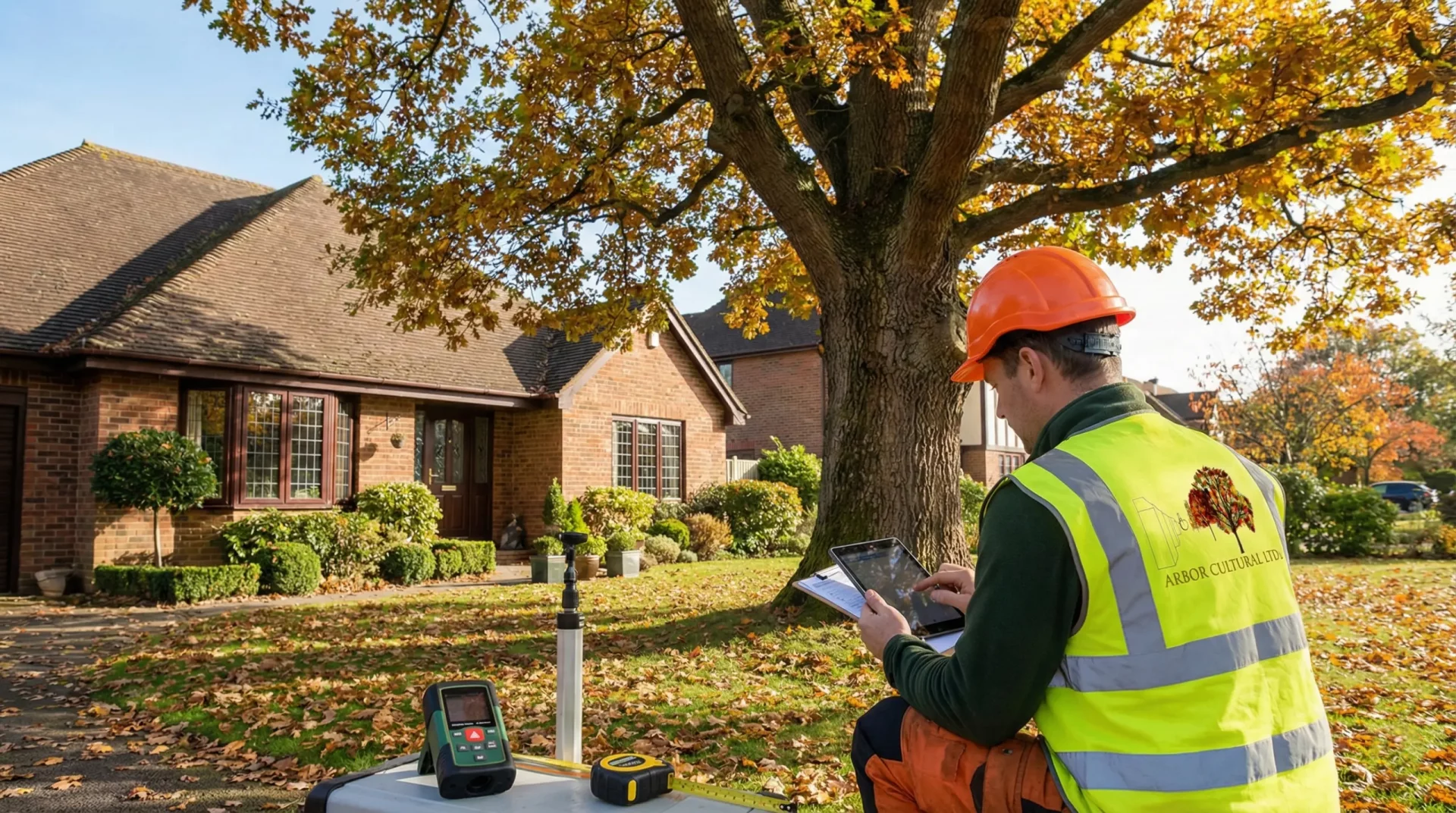
Trees may constrain the layout
Survey and constraints information can help the architect understand tree relationships before building positions and access are fixed.

Get the clarity you need for your planning application, development or council request.
Send us a few details and our arboricultural consultants will review your requirements and help identify the appropriate BS5837 tree report and planning documentation.
Enter your email address to get started. We’ll guide you through the rest.
An Arbor Cultural consultant will review what you sent and prepare the appropriate quote using the email address provided.
Quick to completeAbout 60 seconds
No obligationReview before you instruct
Consultant reviewedArboricultural expertise
Use the form above or email the documents you already have. You do not need to decide whether the project needs a TCP, AIA, TPP or AMS before getting in touch.
A BS5837 tree report turns site survey data into practical arboricultural information for design and planning. It helps the project team understand which trees matter, where the constraints sit and what further arboricultural work may be relevant as the proposal develops.
BS5837 information can be relevant when trees on or near a site may influence a development, access, parking, foundations, services, demolition or construction. The exact documents depend on the proposal and Local Planning Authority rather than one universal package.
Survey and constraints information can help the architect understand tree relationships before building positions and access are fixed.
Send the exact validation request, planning condition or tree-officer wording rather than trying to translate the acronym yourself.
Neighbouring trees can still matter where crowns or rooting areas extend toward the proposed development or construction activity.
Tree constraints can interact with foundations, drainage, surfacing, level changes, demolition logistics and temporary access.
The next step may be a TPP, AMS, condition information or supervision rather than another baseline survey.
The form above or email route lets you start with the real project information rather than guessing which report title applies.
BSI describes BS 5837:2012 as the standard containing recommendations for trees in relation to design, demolition and construction. Its guidance follows a sequence intended to help integrate tree care with development and existing structures. Check the current status and published information directly with BSI.
The exact deliverables depend on the agreed scope. A report should make clear what has been surveyed, what constraints matter and what the project team should consider next.
Relevant tree references, species, dimensions, condition, life stage, remaining contribution and BS5837 categorisation.
Crowns, Root Protection Areas and other spatial relationships presented so the design team can understand where tree constraints sit.
Professional commentary explaining the significance of the tree stock and the issues most relevant to design and planning.
Consideration of tree-building separation, access, levels, hard surfaces, services and other project features where relevant to the scope.
An explanation of whether further work such as an AIA, TPP, AMS or supervision may be relevant to the project.
Agreed documents prepared for practical use by the client, architect, planning consultant and wider project team.
Searches for “tree survey”, “tree report”, “BS5837 report” and “arboricultural report” often describe overlapping needs. The useful distinction is between collecting tree information and interpreting it for the planning stage.
The survey records the relevant trees and characteristics needed for the agreed development scope.
The report explains what the survey information means for the site and the project, then connects it to the relevant planning or design stage.
“BS5837 report” is often used as an umbrella phrase. The table below separates the main documents by purpose so the project team can understand the sequence without assuming every application needs all of them.
| Document | Main purpose | Usually useful when | Question it answers |
|---|---|---|---|
| BS5837 Tree Survey / ReportBaseline information | Records and interprets the relevant tree stock. | Early design, planning preparation or when trees may influence a proposal. | What trees are present and what constraints should the team understand? |
| Tree Constraints Plan (TCP)Spatial constraints | Plots crowns, RPAs and other relevant constraints. | Before or during design development. | Where are the tree-related constraints on the site? |
| Arboricultural Impact Assessment (AIA)Development effects | Explains the arboricultural implications of the proposed layout. | Once a meaningful design proposal exists. | How does the proposal affect trees and how are those effects addressed? |
| Tree Protection Plan (TPP)Construction protection | Shows practical protection measures for retained trees. | Planning submission, condition discharge or pre-commencement stages. | Where are protection barriers and controlled construction areas? |
| Arboricultural Method Statement (AMS)Working methodology | Sets out how sensitive operations near trees should be carried out. | Where construction activity needs controlled methods close to retained trees. | How can specific work be completed while managing arboricultural constraints? |
| Arboricultural SupervisionConstruction-stage oversight | Provides consultant attendance and records where required by scope or approved methodology. | During sensitive works or where planning conditions require arboricultural involvement. | How are the approved tree measures being implemented on site? |
A report can contain a lot of technical information. For most design and planning decisions, these are the sections that explain the important story of the site.
Start with species, dimensions, condition and category. This establishes the basic quality and physical character of each relevant tree or group.
Check crown spreads, RPAs and tree positions against the site base. This is where spatial relationships become visible.
If a design exists, look for how the proposal interacts with retained trees, removals, access, surfacing and construction activity.
Identify any TPP, AMS, supervision or further information needed to move from planning into implementation.

A BS5837 report is strongest when the tree information can be coordinated with the actual site, current proposal and original planning wording.
Species, stem diameter, height, crown dimensions, life stage, condition and other agreed BS5837 survey fields provide the evidence base.
Good base information helps locate trees and constraints against boundaries, buildings, levels, access and the emerging proposal.
An impact assessment needs a meaningful design to assess. Validation requests and conditions should be supplied in their original wording wherever possible.
Tree Preservation Orders and conservation-area controls are separate planning considerations. GOV.UK guidance explains that protected trees are subject to specific controls, and planning authorities can use conditions to protect trees where appropriate.
Ownership is not the same as planning relevance. A neighbouring tree may need to be considered where its crown, rooting area or likely construction relationship extends toward the development site.
Tree-related planning issues are often easier to deal with when the survey, drawings and planning request are aligned from the start.
Late tree constraints can leave fewer practical options for building positions, access, parking and hard landscape.
An AIA based on an old layout can quickly become irrelevant. Always send the latest revision and identify material design changes.
Off-site crowns and roots may still influence a proposal even though the tree sits outside the ownership boundary.
BS5837 category is one part of the planning picture and does not override policy, protection status or design judgement.
Where work is close to retained trees, site-specific protection or methodology may be more useful than generic statements.
The exact validation request or condition often reveals more than a summary such as “the council wants a tree report”.
The strongest BS5837 work is not a tree schedule generated in isolation. It links the evidence to the decisions the client, architect, planner and construction team actually need to make.
Arbor Cultural provides consultancy advice rather than tree-surgery contracting. Recommendations are therefore not tied to selling pruning or felling work. The emphasis is on proportionate scope, clear evidence and continuity into later planning stages where needed.
CAS qualifications, Arboricultural Association professional membership and specialist arboricultural training.
LANTRA Professional Tree Inspection training supports wider tree assessment competence.
Bond Solon expert witness training supports careful evidence handling and professional reporting.
More than 20 years of arboricultural experience across planning, tree inspection and specialist consultancy contexts.
Use the form above or email the site details, current drawings and any council or architect wording already available.
The likely BS5837 stage, required documents and information gaps can be reviewed before a fixed-fee proposal is issued.
A consultant records the agreed tree data and translates it into the report and drawing information included in the scope.
If the proposal later needs an AIA, TPP, AMS, condition information or supervision, the next arboricultural stage can be explained clearly.
A meaningful fee depends on the site and the documents actually required. The aim is to price the professional scope the project needs rather than automatically bundle every possible BS5837 stage.
Send the information already available. It is usually more useful to review real project material than to make you choose a technical report from a dropdown.
Use the form above or email the documents directly. A consultant can review the likely BS5837 stage before you instruct.
Short Arbor Cultural briefings covering planning information, arboricultural reports and development around trees. Videos load only when selected.
A short Arbor Cultural briefing on the tree information that can be relevant to a planning project.
A consultant-led look at how arboricultural reports fit into the wider planning process.
A short briefing on the practical relationship between trees, design and development.
Independent feedback from clients who have instructed Arbor Cultural for planning, property and specialist arboricultural work.
Verified client feedback is already displayed elsewhere on this page.
VIEW ALL VERIFIED REVIEWSArbor Cultural supports planning and development work across Greater London, Surrey, West Sussex, East Sussex, Kent, Hampshire, Berkshire, Buckinghamshire and Oxfordshire. Local validation requirements vary, so the professional scope should follow the actual authority, site and proposal.
Dense sites, neighbouring trees, basements, access and close tree-building relationships can make early tree information especially useful.
Mature garden trees, boundaries, access changes and protected-tree context commonly interact with planning proposals.
Tree constraints can interact with layout, access, drainage, levels and construction logistics across a wide range of sites.
Planning sites can involve retained trees, neighbour relationships, level changes and varied topography.
Projects range from domestic planning to larger development where tree retention and mitigation need early consideration.
BS5837 input can continue from early constraints through planning and construction-stage arboricultural requirements.
Mature trees and constrained plots can create important design relationships around access, buildings and future amenity.
Tree constraints can influence layout, access and construction methodology across a wide range of development types.
Early arboricultural information can help project teams understand retention priorities before design becomes fixed.
You do not need to understand every BS5837 acronym before contacting Arbor Cultural. If you have planning, council or architect wording, send it exactly as received.
A BS5837 tree report uses tree survey information to explain the arboricultural context of a development site. Depending on the agreed stage, it can sit alongside a Tree Constraints Plan and lead into an Arboricultural Impact Assessment, Tree Protection Plan, Arboricultural Method Statement or later supervision.
The tree survey is the field-data stage. The report interprets that information for the planning and design context. In practice, people often use the terms together, so the important point is to confirm the actual deliverables required for the project.
Where trees on or close to a site may influence a proposal, early BS5837 information can help the design team understand constraints before the layout becomes fixed. The exact planning requirement depends on the site, proposal and Local Planning Authority.
No. A BS5837 report provides professional arboricultural information for the planning process. The planning decision remains with the Local Planning Authority and depends on the wider merits of the application.
Potentially. Where trees are relevant, a planning authority may ask for appropriate arboricultural information before it can assess the proposal. Validation and information requirements vary between authorities and applications.
No. The required documents depend on the proposal, design stage and planning requirements. A consultant should confirm the appropriate combination rather than assuming every project needs every BS5837 document.
A Tree Constraints Plan maps tree constraints for design. An Arboricultural Impact Assessment considers the effects of a proposed layout. A Tree Protection Plan shows practical protection measures, while an Arboricultural Method Statement sets out how sensitive work near trees should be carried out.
The agreed survey scope normally records information such as tree reference, species, stem diameter, height, crown dimensions, life stage, general condition and BS5837 categorisation, together with information needed to illustrate relevant constraints such as Root Protection Areas.
The Root Protection Area is a planning and design tool derived using BS5837 recommendations to indicate the minimum rooting area associated with a retained tree that should be considered through design and construction planning. Site-specific conditions still matter.
Yes. A tree does not need to be inside the application boundary to be relevant. Off-site crowns and rooting areas can extend into the site and may need to be considered where they interact with the proposal.
No. BS5837 categorisation helps communicate tree quality in the development context, but it does not replace planning policy, tree protection status, landscape considerations or professional design judgement.
They can. Tree Preservation Orders and conservation-area controls are separate planning considerations. The presence of protected trees should be checked and considered alongside the development proposal and any arboricultural report.
Often, yes. Where significant trees are present, early constraints information can help the design respond to the site before building positions, access, parking and hard landscape are fixed.
Yes. Good site and design information helps coordinate tree constraints with boundaries, buildings, levels and the proposal. Send the latest topographical and architectural information available when requesting a quote.
Send whatever already exists: the site address, planning or council wording, current drawings, topographical survey, previous tree information, planning reference, photographs and any genuine project deadline. You do not need a perfect information pack to start.
The fee depends on the number and distribution of trees, site size and complexity, access, available drawings, location and the documents required. Arbor Cultural can provide a fixed-fee proposal once the scope has been reviewed.
Timescales depend on survey availability, site complexity, access, drawing quality, the documents required and current workload. Include the real project deadline in the enquiry so the expected programme can be considered before instruction.
The next arboricultural requirement may relate to planning conditions, Tree Protection Plans, working methodology, pre-commencement information or supervision rather than another baseline report. Send the decision notice and exact condition wording.
Yes. The regional coverage on this page includes Greater London, Surrey, West Sussex, East Sussex, Kent, Hampshire, Berkshire, Buckinghamshire and Oxfordshire, with named towns and localities shown in the coverage section.
Use the form above or email the project documents you already have. Arbor Cultural can review the likely professional scope before you instruct.
No obligation · Consultant reviewed · London & South East
Tom Thompson
Hi, I'm Tom. I can help you with all your tree related queries in 60 seconds!